Q&A with Cecile Pin, Author of Celestial Lights
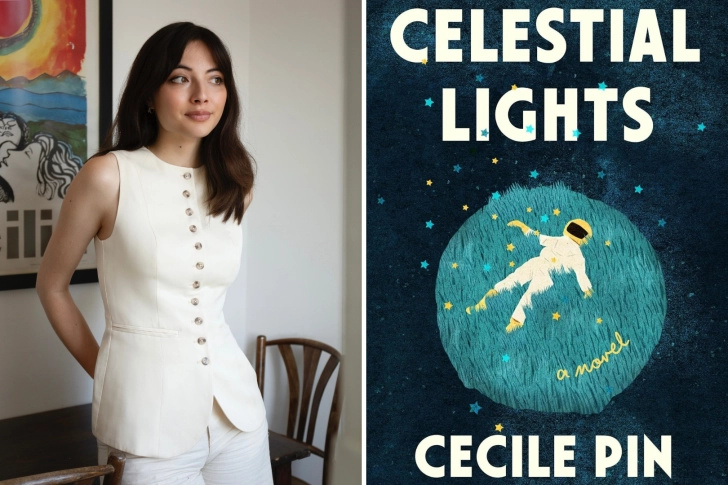
Cecile Pin is the author of Celestial Lights, which is available now.
Wandering Souls, her first novel, was long-listed for the Women’s Prize for Fiction, the Carnegie Medal, the Prix Femina Étranger, and was short-listed for the Waterstones Debut Fiction Prize. She has won the Fragonard Prize for Foreign Literature, a Somerset Maugham Award, and a London Writers’ Award. In 2025, she was selected as one of Forbes’ 30 Under 30 Europe.
Celestial Lights is loosely inspired by the myth of Odysseus and shifts this classic tale into the contemporary. It follows an astronaut who is commissioned for a groundbreaking adventure into space, however, for the entire ten-year journey, they will lose all communications with Earth.
Let’s get to know Cecile as she talks favorite novels, research behind her story, her TBR and more!
What are some of your favorite novels?
The list varies a bit depending on my mood, but some all-time favourites include One Hundred Years of Solitude by Gabriel García Márquez, The Memory Police by Yōko Ogawa, Norwegian Wood by Haruki Murakami, and Tender is the Night by F. Scott Fitzgerald.
When did you know you wanted to become an author?
I don’t think there was a single moment in particular. I’ve always enjoyed the act of writing, and creative writing was probably my best subject at school – but I didn’t really think of it as a viable career option! As a teenager I thought of becoming a screenwriter, then a journalist, and then an academic. It’s only when I was in my early twenties, and began work on my first novel, that I realised fiction was what I really loved writing.
Can you detail the inspiration behind Celestial Lights?
I’ve always find it fascinating how our universe surrounds us, is all-encompassing, yet remains so full of mysteries. I was also interested in the dichotomy of writing a novel that, while having some sci-fi elements, retained a very humane and grounded core.
At the time, I was also thinking a lot about notions of ambition and relationships: what happens when these two things come into conflict? We see that struggle a lot in our culture, whether through athletes forsaking retirement at the expense of their health, artists shutting themselves away to create their work, scientists conducting their research days and nights… our personal lives and private goals do not always align, and often, we have to sacrifice elements of one or the other. I wanted to write a protagonist wrestling with that conflict, too.
What type of research did you conduct for the story?
My Alma Mater, University College London, let me attend some lectures on astrophysics and our solar system, which gave me much-needed basics on those topics. I also read books like The Future of Humanity by Michio Kaku to get a better idea of some of the challenges that space travel face, and the directions it’s taking. I read British Astronaut Tim Peake’s autobiography Limitless, which gave me a better grasp on the workings of the European space industry (though I’ve fictionalised it in my novel), and life on the International Space Station.
The NASA and ESA websites are also incredibly thorough and contain a lot of information on their current and past missions and the technologies they’re working on. I love this interactive rendering of the Solar System that NASA has, which allows you to see celestial bodies and the spacecrafts currently in their midst.
What was your favorite chapter or part to write?
I liked writing the University chapters. They made me feel nostalgic for that time (like my protagonist Ollie, I left my home at eighteen to attend university in London), and made me reflect on my own journey since then.
It’s also a really formative time for Ollie: it’s the first time readers meet him untethered from his family and home, trying to find out who he is and who he wants to become. Furthermore, it’s when the novel starts incorporating some of it’s more speculative elements, including the space mission and some of the technologies and science advancements that our real world do not have. Drip-feeding some of that information, while shaping Ollie’s character in a way that felt effortless and didn’t weigh down the plot, was an interesting challenge!
What are you currently reading and what’s on your TBR (to be read) list?
I’m currently reading Kitten by Stacey Yu, a debut novel that’s coming out this summer. Non-fiction wise, I’m reading the essay collection Crossing the Wine-Dark Sea by the classicist Emily Wilson. Up next, I’m very much looking forward to reading Ply, the new novel by Hernan Diaz, as well as Sky City by Jacqueline Crooks.
About the Author