Q&A with Glenn Dixon, Author of The Infinite Sadness of Small Appliances

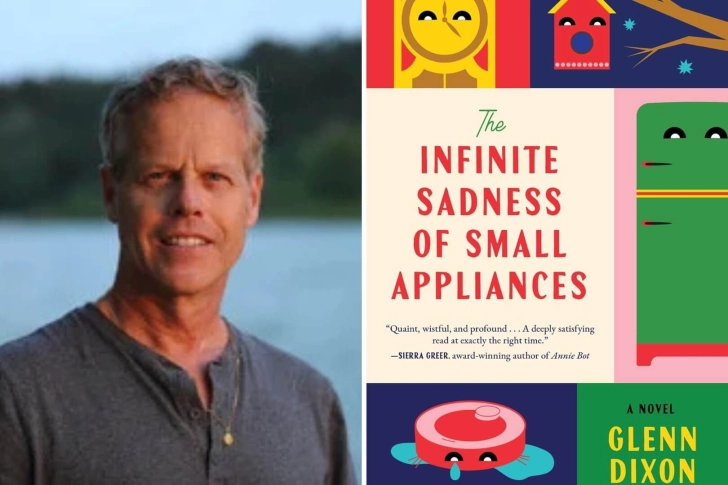
Glenn Dixon is the author of The Infinite Sadness of Small Appliances.
Glenn Dixon is an author, documentary filmmaker, and musician. His book Juliet’s Answer was The Globe and Mail national bestseller and has been published in twelve countries and translated into German, Spanish, and Chinese. He has traveled through seventy-five countries and written for National Geographic magazine, the New York Post, The Walrus, and The Globe and Mail (Toronto).
The Infinite Sadness of Small Appliances is a heart-warming and joyous love letter to books and the power of connection found in the most unexpected places, featuring Scout the sentient Roomba.
In a world where house items are sentient, they must work together to save their elderly owners home from being torn away from him.
Let’s get to know Glenn as he talks favorite novels, inspiration behind the story, his TBR and more!
What are some of your favorite novels?
I’ve recently gone back to re-read some of the novels I loved when I was young. At the moment, I’m re-reading Watership Down. It’s funny, isn’t it? Not only is this a timeless beautifully told story but it also brings me back to the person I was when I first read it. I’ve always loved books that take me on a journey.
The Hobbit was another one of those pivotal books for me (I probably read it when I was 12). In fact, I was just messaging back and forth with a bookstore owner in New Zealand who cried when she read my novel, and the reason was that I’d mentioned the Lion, the Witch and the Wardrobe. Well, she has a room in her bookstore she calls the Narnia Room and she’s set it up so that you can only enter it by literally walking through a large wardrobe. Isn’t that wonderful? These things stay with you and after all these years there’s still magic in them.
When did you know you wanted to become an author?
My mother was a librarian and school teacher and she read to us (there were four siblings, all quite close in age, and we’d sit at her feet, mesmerized by the stories). That was a very big thing for me. And, now, this might sound pretentious, but I remember reading the Brothers Karamazov when I was about 17 and that was the one that did it. I thought, wow, are you allowed to write like that (I’m thinking of the famous Grand Inquisitor scene in that book – in which a judge puts God on trial for the crime of giving us free will). Whole worlds were opened up to me in those books and I guess I just knew that that’s what I wanted to do too.
What is the inspiration behind “The Infinite Sadness of Small Appliances“?
From this same time period– when I was a teenager – I had a fascination with science fiction and I distinctly remember reading a novella in monthly magazine called Science Fiction and Fantasy magazine. The story was called the Brave Little Toaster. It has since been made into a movie – well, maybe a couple of movies – but nothing tops the original. That one stuck with me and it came to me that I could write something like that – especially in this age of artificial intelligence. I really just started writing almost blindly.
Tolkien talks about having a single sentence pop into his head: “In a hole in the ground there lived a hobbit.” Well for me, it was: in the pantry there lived a Roomba vacuum cleaner. That’s all it took. And I can tell you, The Infinite Sadness of Small Appliances was an absolute joy to write.
I love the uniqueness of featuring a young Roomba mesmerized by listening to To Kill a Mockingbird. Why was that the right title to start the Roomba’s journey?
That one comes from my years of being a high school English teacher in Canada. To Kill a Mockingbird was required reading for the students (I taught it semester after semester) and I think what I liked about it was the character of the girl, Scout. She was young and completely innocent and you see the world through her eyes as she comes to understand justice and what it is to be true to yourself and your values.
What was your favorite chapter or part to write?
In my book, there are a number of scenes in the kitchen, where it’s late at night and the Humans have gone to bed. This is the time that the appliances talk to each other, especially Scout, the young Roomba vacuum cleaner along with her friends, Fridge and Clock. They discuss philosophy and beauty and poetry and all sort of things and I absolutely loved writing those sections. The appliances have very distinct personalities and their ruminations run from the truly profound to the completely hilarious. Those were a lot of fun to write.
What are you currently reading and what’s on your TBR (to be read) list?
I’m currently reading Land by Maggie O’Farrell because I was a big fan of Hamnet. I’d written about Shakespeare in one of my earlier books (Juliet’s Answer) so that led me to her writing. I’m probably most looking forward to Exit Party by Emily St. John Mandel. She wrote Station Eleven (highly recommended and yes, bits of Shakespeare in there too). It doesn’t come out until September but I can hardly wait.
And, it’s just been announced that Kazuo Ishiguro will have a new book out next year. It’s called Miss Lambert Steps Aboard Danger (which I think is a brilliant title). His Klara and the Sun is probably one of my favorite books of the last few years.
About the Author