
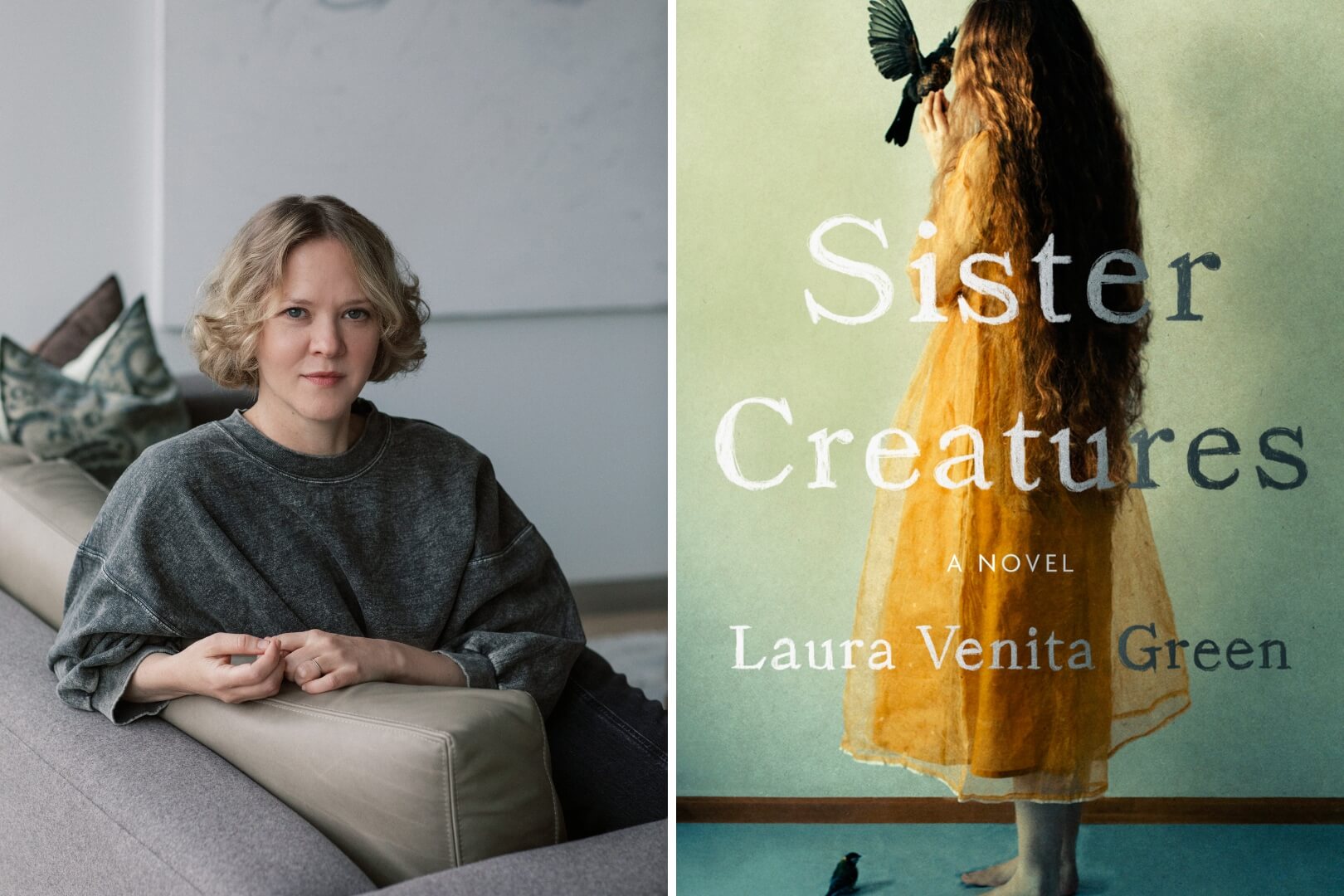
Laura Venita Green is the author of Sister Creatures, which is out now.
Laura Venita Green is a writer and translator with an MFA from Columbia University, where she was an undergraduate teaching fellow. Her fiction won the Story Foundation Prize, received a Pushcart Prize Special Mention, and appears in The Missouri Review, Story, Joyland, Fatal Flaw, and translated to Italian in Spazinclusi.
Her translations appear in World Literature Today and The Apple Valley Review. Born in San Angelo, TX, she’s lived in New Orleans and now lives with her husband in New York City. Sister Creatures is her debut novel.
Sister Creatures is about manufacturing resilience from nothing but the bonds that tie us together.
Let’s get to know Laura as she talks favorite books, the importance of the setting, her TBR and more!
What are some of your favorite novels?
The novel I recommend to everyone is Mrs. Caliban by Rachel Ingalls. It’s so wonderfully weird, and very poignant. To me, it’s the ultimate book club read because it requires reader interpretation. I encountered this book in a horror class led by Paul LaFarge, and it made for the liveliest discussion, each reader certain that their reading was “correct.” Very fun!
Station Eleven by Emily St. John Mandel is an all-time favorite and perhaps the book that truly made me want to write, with its nonlinear structure, multiple points of view, and astonishing ending.
I also really love reading books in translation, and the two favorites that I would most love to sit down and discuss with other readers are Taiwan Travelogue by Yang Shuang-Zi (translated by Lin King) and Little Eyes by Samanta Schweblin (translated by Megan McDowell).
When did you know you wanted to become an author?
I didn’t write my first creative word until the age of 31. I was finishing up an MBA in finance and realizing I didn’t want to spend my life pursuing a finance career. My favorite thing to do was to read, and I thought, I’m smart and I don’t mind tackling difficult projects, I should be able to whip out a novel. Ha! What it actually took was a decade of learning and practicing, four years writing my debut novel, and another couple of years to find an agent and a publisher and get it out into the world. Quite the journey!
What inspired you to write Sister Creatures?
The very first seed came from a translation workshop I was in, when a fellow student brought in a translation of a German poem that included the word “sistercreature.” The word, which made me think of “doppleganger,” stuck in my head for months, until I finally tried my hand at a doppelgänger story, where I wrote into existence one of the key storylines and a couple main characters in my novel. From there, the entire process was a sense of discovery. I knew I wanted to write about the places where I grew up, primarily in Louisiana and in Germany, and about home—the idea that once we leave home, we can never truly return. I knew I wanted to write about women, complicated and flawed women, and about female relationships and power dynamics. And I knew I wanted to include speculative elements to enhance the very human stories I wanted to tell.
Tell us how the setting in Pinecreek, Louisiana, sets the tone for the story.
Pinecreek, the fictional rural town in Louisiana, plays such an important role in this story. From the very start, it does a lot of work in revealing my main characters’ psychologies, as I got to bring this place to life through a few different points of view. Tess, who at age twenty feels her life has already imploded, notices all the oppressive elements: the heat, the humidity, the bugs swarming everywhere. Lainey, who loves the place and doesn’t want to leave, notices the beauty and the opportunities to connect with nature. Olivia, ready to go away to college, is nothing but dismissive of the place.
Only the first third of the novel is set in Louisiana, yet wherever my characters go, they’re still from a conservative area in the Bible Belt where everyone knows everyone’s business. Where people are just as intelligent as anywhere else despite limited educational and cultural opportunities. Where people talk a certain way and are taught to think a certain way. This setting stays with these women wherever they go. It informs how they move through the world.
What was your favorite chapter or part to write?
The first chapter was incredibly fun to write, because I wrote it very late in the process after I already knew the main characters at later points in their lives. I knew my protagonist Tess as woman in her mid-thirties, moving with her family to an army base in Germany; Gail as a forty-year-old professional woman in New York City; and Thea (an entity that shows up in many forms throughout the novel) as a forest-dwelling shapeshifter. The way I tackled the opening chapter was to take the three of them (Tess at age 20, Gail at 15, and ageless Thea in the form of a creepy doll), put them in a room together, and let them do their own thing, fully alive.
What are you currently reading, and what’s on your TBR (to be read) list?
I’m currently reading an advance copy of Daytime Moon by Kerri Schlottman, out with Unnamed Press in May 2026. It is absolutely stunning! My TBR is extensive, but a few at the top are Guatemalan Rhapsody by Jared Lemus, The Book of I by David Greig, and The Unworthy by Agustina Bazterrica (translated by Sarah Moses).