Interview with Gerry Rich, Author of Chasing Hollywood

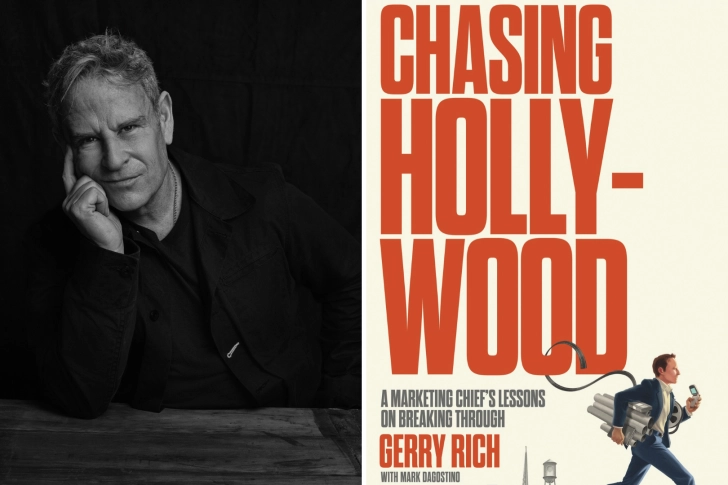
Gerry Rich is the author of Chasing Hollywood, which is available on October 13th.
Gerry Rich was just a kid when he set his sights on marketing movies. That’s when his journey of Chasing Hollywood began: By forging new paths to escape the confines of his St. Louis neighborhood, he innovated his way to California, scrappily climbing from a humble post-college advertising job to the top of the Hollywood food chain.
Named by Ad Age as one of the Top 100 Marketers in America (across all industries), Gerry has proven his talents as a marketing executive at Columbia Pictures, DeLaurentis Entertainment Group, Miramax, Miramax/Disney, MGM, Paramount, and MGM/United Artists. He has also consulted for Universal Pictures, and for some of the world’s top film financiers.
Chasing Hollywood
Book Club ChatRecommended readChasing Hollywood: A Marketing Chief’s Lessons on Breaking Through
by Gerry Rich
View on AmazonI had the pleasure of interviewing Gerry over Zoom, and he’s a delight! So warm and kind, and I found his story so inspirational. I edited and condensed the interview to fit the Q&A format. Check it out here!
What inspired you to write your memoir now?
It was the right opportunity. It was not something, as others are more likely to say, they wanted to do their entire life. It was not something that even crossed my mind. But for over three decades, I’ve been marketing stories and marketing storytellers. And then I got to this point in my career, and there is this major shift happening in the industry at the same time, where it was so transformative, some for the good, some for not, that it really was a time for me to reflect on my journey.
And so that’s why I did the story, because I got to a point where, after marketing stories and storytellers for three decades, I wanted to tell a story, and this is the story I know best.
Each chapter ends with an insight. Can you talk about why it was important to include these insights?
The lessons part of it was something that I had no intention of doing, but at the end of each chapter, I reflected back on my takeaway from those moments, and they were really salient. Every time I read those chapters, I rewrote the learnings to be as relatable and insightful to as many people as possible. Particularly when you find yourself in a place where it doesn’t feel good, you may not know why you’re there; you may have to jump ship, but you have to take a step back and say, this is maybe where I’m supposed to be at this very given time, at this very moment.
I wanted to reach a much broader audience and talk to people, not necessarily even those who pursue film, but who have dreams and feel like they are out of reach, and I wanted this to deliver to different people in different ways.
I didn’t want to call them lessons because it feels like homework, but rather insights; I thought it would be helpful to anyone who has a destination that feels incredibly challenging or impossible.
The worst thing anyone can do is have a road map, but have complacency and expect that things are just going to fall into place. But it requires a lot of movement; you have to zig when you thought you had to zag. So it’s about focus, dedication, and staying present with what you want to do. And the best way you can do it.
Can you talk more about this distinctive look into Hollywood?
This is a very unique perspective of Hollywood that hasn’t been shown before; it’s a little like Mad Men meets The Studio or Entourage, but the marketing perspective has never been pursued through that lens.
And I think there are a lot of people, whether you’re a content creator or whether you’re a brand specialist, marketing is so instrumental to virtually everything. I’m happy about this book; it really does give that marketing insight and lens into the filmmaking world.
Tell us about what it was like to record your own audiobook.
That’s so interesting, because obviously, I’ve never done anything like it, but it was really important to me that I did do my own audiobook.
HarperCollins picked a studio in Hollywood for me, because I live in Hollywood. And I went in, and I didn’t know what to expect. I was surprised how much time they blocked for it: five days, with a rigid schedule of 10-5, with 1-hour breaks.
And so I really got a sense of what it’s like to be voice talent, because that’s how that day goes. You’re voice talent, and you’re reading, and you’re performing it, you’re putting your emotion into it, you’re putting humor into it, you’re putting the right inflection, you’re reading it at the right pace. If there’s any fatigue, you’re rereading it.
I’m so happy I did it, because I felt nobody else could have done the audio to reflect the nuance of that emotion I was feeling. I wanted to get it right, and I was so happy to have the professionals around me to help.
You know, Heather, I’ve never been on the other side, so I’m usually on the other side of the glass, like looking at Seth MacFarlane to do Ted. So I have spent my time on the other side of the glass, and it’s a real privilege and a treat and an opportunity I never thought I’d have to be on this side of it.
What was it like to reflect on so many different aspects of your career?
These are authentic stories in a different period with larger-than-life personalities, and that’s what’s changed in the entertainment business. When I grew up as a kid in the entertainment business, there were moguls.
These are Cubby Broccoli, who started the Bond franchise, and Sherry Lansing, and of all these people with the bravado and the style, these people had movies that ran through their veins. They were a different breed from the kind of tech guys today.
And these filmmakers of that period are quite a bit different, and these were just true showmen. They’d get movies made that can never get made today. And there aren’t that many of them left, and that’s why I think the story, through the lens of marketing, is really unusual.
What are your thoughts about this recent surge of book-to-film adaptations?
I think it’s great to see adaptations, but not all are created equal. For a marketer, it’s wonderful to have a film with a built-in fan base who are excited to see a book they love, adapted for the big screen.
While Verity was panned by the press, the book fans showed up in big numbers and were the locomotive for the weekend success. Book fans want to know how the writer feels about the adaptation and want their reassurance that the adaptation is faithful to the source material and that the author approves of the casting and end result.
Project Hail Mary is another example of a well-executed faithful adaptation. Not all work, obviously. Some don’t translate well, or some are executed poorly, upsetting the book fans.
About the Author