
Review: Partita by Barbara Kingsolver

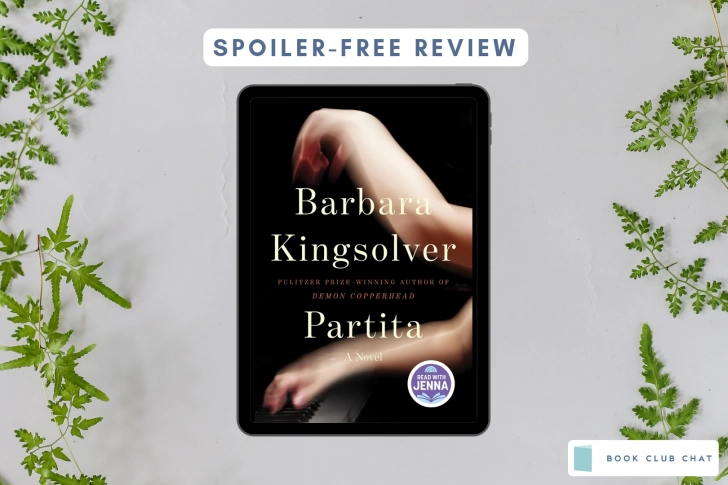
Partita by Barbara Kingsolver is a quiet novel about chasing dreams, life-altering tragedies, and learning to accept the past.
Barbara Kingsolver is a well-known author of acclaimed works, including the Pulitzer Prize-winning Demon Copperhead. I somehow haven’t read that novel yet, so Partita is actually the first novel I’ve read by her.
When I finished Partita, I wasn’t a little unsure of how I felt about it. I had extremely high expectations, maybe a little too high, and I didn’t get as emotionally invested as I anticipated, at first.
On one hand, there’s no doubt her writing is exceptional and transformative. You do feel you’re on this very hard journey with the protagonist, Livia. From her time in college to the rural farm in Tennessee, it all felt vivid.
After finishing the novel, I gave myself a couple of days before writing this review and discussion questions. I even reread parts.
I actually found myself feeling the emotional impact more so, and understanding the greater message beyond this story. But I still wouldn’t call this a five-star read for me.
What’s the Story About
Livia is fine with her seemingly modest life as a farmer’s wife in rural Tennessee. But a surprising phone call from her ex-lover from college brings everything to a halt.
Now she’s faced with memories, some good but also many bad, as she grapples with her past, her present, and where her future lies.
The story is told in two timelines: when Livia is growing up in Tennessee, her college life, and in her 50s back on her family’s farm. When she’s young, she has huge dreams of becoming a successful pianist, but several decisions, including falling in love with a complicated man, take her life in a completely different direction.
Heather’s Book Club
Pursuing One’s Dreams
Everyone has a dream at some point. Of course, you ask children, and they give you all these amazing answers. But many people in college aspire to obtain their dreams as well. Sometimes they are able to achieve it, while others have to settle for what life hands them.
Much of this novel is looking back at what it’s like to feel like you’re close to your dreams, but then certain events change everything forever. There’s a melancholy tone to it all, until the discussion becomes who music is for, and what its purpose is. Is it to achieve huge fame and success, or is it just as rewarding to teach the neighborhood kids a passion for music as well?
Livia grew up in rural Tennessee to an angry mother and a passive father. Her brother died by suicide as a teenager, and it changed her family for good. But her mother never let up on her biting criticism and seemingly almost hatred toward her own child.
As a result, Livia will do anything to escape, and music serves as this refuge. She eventually earns a scholarship to study music at a university in Indiana. But when she meets the charming Sigurd, it changes her path for good.
Farm Life Reflections
As you can tell, this book is well thought out, emotional, and sad.
But yet, something that held me back from loving it. It was the same feeling after I read Tom Lake, which is also a story that features a farmer’s wife (named Lara) reflecting on her past, former love, and career decisions. Although Lara in Tom Lake seemed more content with her farm life, Livia of Partita is very much living in the what if mentality.
It wasn’t that long ago that I read Tom Lake, so maybe that’s why that story is so fresh in my head. For a while, I really kept comparing the two; however, Partita does go in its own direction with trauma. So it’s not like you’re reading the same story twice, but I think I’m ready for a literary story that doesn’t feature a farmer’s wife looking back with regret and wonder.
I enjoy quiet stories and literary fiction, so it’s not that. But I’m trying to put my finger on why both of those stories didn’t resonate with me as much as I would have liked.
Oh well. Maybe the characters Lara and Livia should meet together and share stories. I think they both could use another friend.
The Music
Partita is about the pursuit and love of classical music, with even the chapters structured like a piece of music, a classical Baroque dance suite. Music is so essential to this story that there’s a list of referenced works that you can listen along to (the publisher even made a Spotify list).
Also, the audiobook even features classical recordings while reading the story. So there are so many different ways to be immersed in this classical world, which I thought was such an interesting and lovely touch. Not something you get every day with a new novel.
That said, I did not choose this immersive experience. I’m more of a straightforward reader, even though I’m sure adding the music element while reading is probably enjoyable.
But maybe it makes the story that much richer. Could that be why I felt something was missing?
Let me know if you did listen to the recommended playlist. How did it impact your reading experience?
Verdict
There are aspects of Partita that are emotional, heartbreaking, and beautifully written. Life has been hard for Livia; she had her dreams snatched away in an instant. But that doesn’t mean her current life isn’t also full of joy and beauty.
The musical elements were fascinating and enriching too. Barbara Kingsolver studied music in college, and her knowledge is quite detailed.
I was somewhat let down by the ending; while in some ways it is complete, I just wanted a bit more resolution. When I did reread it, I felt a little better, but for such a detailed story, I needed a little more.
It’s not my favorite literary story of the year, but I still found it an engaging read. If your book club often reads literary and slower-paced reads, this is another great selection, as there is so much to discuss. You will spend a long time debating Livia’s decisions.
Also, I want to end this with a quote from the novel that I’ll remember: “The point of art is to help you like your life better.” That says it all, right?



I agree with you. The prose is good, and the audiobook narrator is phenomenal, but the book fell flat for me. I never found Livia entirely believable as an aspiring concert pianist, and the accumulation of trauma felt contrived and formulamatic. (Not a word but should be) I enjoy quiet, introspective novels that aren’t plot-driven, but I need to believe in the characters and feel their experiences are authentic. The ending left me with a big yuck. Ultimately, this well-loved book just wasn’t for me.
Yes, completely agree about the constant trauma. 100%. I wanted more from the ending too! I reread it and while I believe I understand the intention better, it still didn’t land like I anticipated or needed it to.