Q&A with Hayley Bennett Lyle, Author of Barefoot King

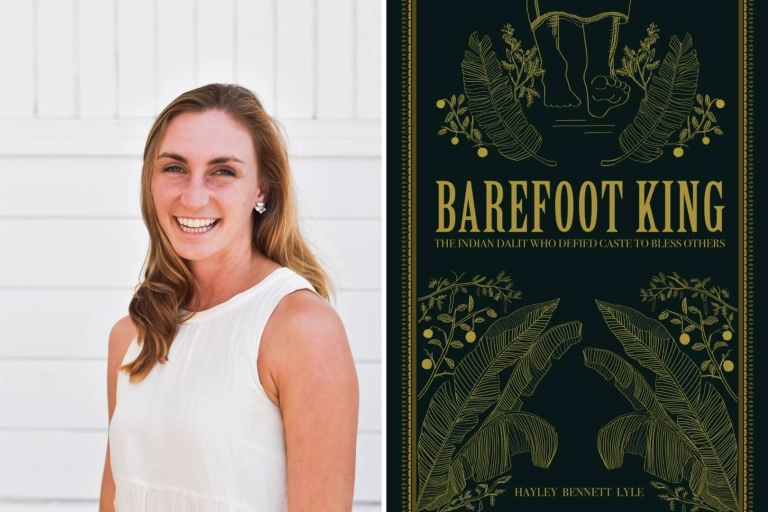
Hayley Bennett Lyle is the author of Barefoot King, The Indian Dalit Who Defied Caste to Bless Others, which is out now.
When Hayley was living in India, she was immersed in India’s vibrant kaleidoscope of cultures, languages, foods, religions, and traditions. This is where she met Raj, and his story captivated her right away.
Here’s a preview of Barefoot King, The Indian Dalit who Defied Caste to Bless Others:
Step into India, 1971— the Dalits, or “untouchables,” are prohibited to wear shoes, politicians rule over justice, and the ideals of India’s young constitution do little against the 2,000-year tradition of caste-based oppression. But for one particular Dalit boy, this was about to change…
Let’s get to know Hayley as she talks more about Raj, key takeaways and their nonprofit!
What are some of your favorite books?
My favorite book of all time is The Scarlet Pimpernel. It encouraged me to have fun with how I described certain scenes, particularly one in which Raj is doing some “undercover” research in a slum to understand the community’s needs.
I also love East of Eden, and while Steinbeck can be rather depressing at times, I love his style and dry commentary on society. I find that he is very perceptive and creates powerful statements by weaving these cultural notations into the story through irony and short chapters.
When did you know you wanted to become a writer?
I was homeschooled for many years which lended to creative assignments I could hurl my enthusiasm into. My first “publication” was about Vikings. I convinced my dad (with all the persuasive powers a cute 8-year-old daughter may have) to spend all of his free hours scanning and photoshopping pictures from an encyclopedia of Vikings so that it could be a picture book. “The Missing Amulet by Hayley; illustrated by: Plagerism.”
Encouragement from my family has been huge in coming to love writing. This encouragement and validation assured me that taking on writing the biography, Barefoot King, was a worthwhile venture.
What inspired you to write Barefoot King and document Raj’s story?
There is something truly powerful in a person who has overcome many obstacles and still retained integrity and kindness.
This is what first struck me about Raj after I had lived in India for a year and saw first hand the complexities of caste, patriarchy, wealth and poverty. Simply put, his life was a story that needed to be told.
On a personal level, the field research, interviews, and writing were my own way of processing what I had experienced in India as well as the polarizing years of Covid which followed. Raj’s life helped me process these events with hope.
What surprised you the most when talking with Raj?
I had already written my second draft of Barefoot King when I hit a writing block. After pouring through my notes I saw my issue was a break in the timeline. I asked Raj and uncovered an event that he hadn’t even been willing to tell his children.
In writing a biography, everything rides on the relationship with the subject and how much trust has been built. It was after more than a year of interviews, traveling to Raj’s birthplace, meeting his extended family, and writing a good chunk of the story that Raj was willing to tell me what happened: the organization that had changed his life as a child, and which he had devoted over a decade working for, dismissed him because of his low caste. While he deserved a promotion, employees refused to work under the supervision of a Dalit. The organization had Raj leave.
While the whole situation was striking, I was particularly surprised at Raj’s reaction to it after all these years. Whether for shame or for wanting to still protect the organization that had poured so much into him as a child, it was a story he had not even told his children, and something that took much bravery and trust to share.
What do you hope are some of the key takeaways of the book and his story?
My chief goal in writing Barefoot King was to make Raj’s story accessible and enjoyable. Raj’s story is filled with poignant themes- injustice, broken systems, bonded labor, caste, and politics- but these themes can be intimidating, hard to grasp or even care about without anchoring them in a real person’s life.
I hope Raj can become a friend, and his story, a bridge.
Can you detail the nonprofit that you launched?
Barefoot King details how Raj’s life completely changed through a non-profit that was willing to invest in him and his education. Raj has devoted his life to carrying out similar child and community development work in some of the most impoverished and societally oppressed communities.
Barefoot King Initiative carries forward this work and legacy. We are launching our first project this year and will be focusing first on supplemental after school programs for children and teaching women to be entrepreneurs. Learn more at barefootking.org!
About the Author