
The Lincoln Highway: Let’s Talk About That Ending! (Spoilers)

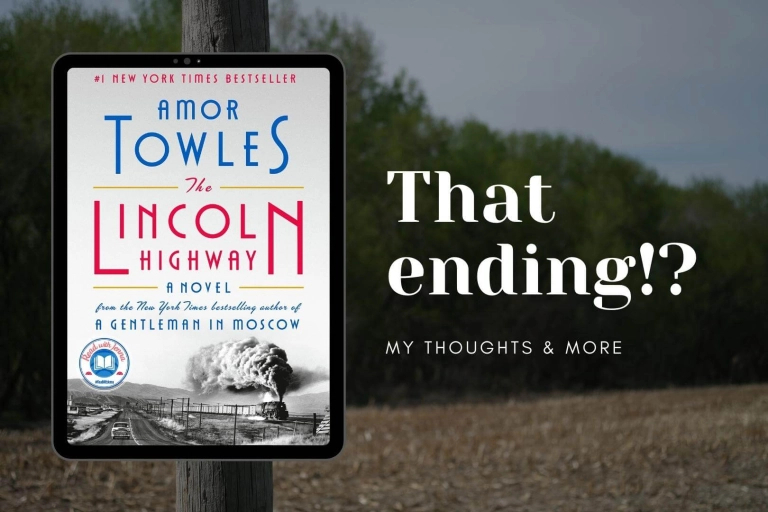
This is a spoiler-filled discussion about the ending to The Lincoln Highway. If you haven’t read the novel yet, wait to visit this post until after you finished it.
Welcome to the discussion about The Lincoln Highway! If you’re new to Book Club Chat, I write spoiler-free reviews and spoiler-filled book club questions for each novel I read. But lately, I’ve noticed some books deserve a third article—one dedicated to shocking endings. So please feel free to comment with your thoughts at the end of the article.
The Lincoln Highway is a coming-of-age tale about the transition from teenager to adulthood. Each of the main characters are at a crossroads of sorts and in a way, the Lincoln Highway serves as a getaway from their current, somewhat bleak situation.
Particularly, Emmett and Billy. This is their chance to leave behind Nebraska and its bad memories and try out California. While Billy hopes they can find their mother in San Fransisco (even though she abandoned the family), Emmett believes they can get a fresh start with fixing and then selling houses (the original house flippers).
But Duchess made a mess of everything. Once he steals Emmett’s car and heads up to New York, it completely delays Emmett’s and Billy’s plans.
From there, we follow Emmett and Billy’s journey to regain the car and they meet an interesting cast of characters along the way.
The Ending
Remember, this is spoilers, spoilers, spoilers from here on out! So don’t read this unless you’ve finished the book. Seriously!
Up until about the last 60 pages or so, the story is fairly straightforward coming-of-age tale with vivid imagery of the time period and lots of pondering about the past and what’s next. So the shift in tone during the climax to the ending was pretty shocking.
Emmett finds Woolly dead in his bed from a suicide. He’s distraught but when he sees Duchess, all Duchess cares about his trying to get Woolly’s inheritance that is locked away. This horrifies Emmett and he’s determined for Duchess to finally go to the police to own up to his crimes and that’s when the two get into a fight. Eventually, Emmett knocks out Duchess.
It turns out Woolly did leave each of the friends his money. So the brothers take their share of the money and plan to finally go to California.
But Emmett is concerned that Duchess will try and find them. So he decides to put an unconscious Duchess on a boat with his own share of the money. The boat contains a hole and Emmett stacks stones in order to stop the boat from flooding. However, once Duchess is awake and the money begins to blow away, Duchess shifts the boat to try and get it—causing it to sink and since Duchess can’t swim, he drowns.
We apparently see a flash before Duchess dies that shows the brothers in California, Woolly alive, Sally with a child and Sister Sarah. Clearly this doesn’t represent the future since Woolly is alive but maybe that flash was simply Duchess’ wishes. I’m not sure—what do you think about that scene?
Key Events
While the ending is shocking, there are hints of something more sinister going on earlier in the novel—Duchess’ random act of violence against the taunting cowboy in Morgen and also to Ackerly, the former warren of the juvenile camp. Duchess tries to justify both but it’s undeniable that those were unprovoked actions and the fact he doesn’t see that is pretty disturbing in itself.
And with Emmett, while he did not kill the bully on purpose back in Morgen, it does sound like he has anger issues and only Billy can get him to calm down. Although, who wouldn’t be absolutely furious with Duchess and his behavior, right?
But let’s talk over several key events. First, was this Woolly’s plan all along—to commit suicide and leave his friends his inheritance? I think so. This is why his interactions with his sister seemed to have a farewell component to it. Very sad and tragic.
I have seen people wonder if Duchess had a hand in Woolly’s death—such as ensuring Woolly would get his sister’s medicine bottle (which I don’t think we ever got the name of). So, maybe he didn’t actually kill Woolly but he also didn’t help to prevent the overdose. I think it’s left vague on purpose.
The second event I want to discuss is the fact that Duchess makes it seem like this trip is an effort to get revenge at his father for framing him and sending him to the work camp. But he never does come into contact with his father—although it seems like he does try. I was disappointed they never had an interaction and that really didn’t go anywhere.
Reading the story from Duchess’ first-person perspective caused the reader to try to sympathize with him but soon it became apparent that not only was he a liar but he’s also a dangerous person. While Duchess probably thought of himself as a hero, he was the villain, in the end. I don’t feel he was misunderstood—I believe his actions were loud and clear.
Emmett’s Motivations
And so let’s talk about the big twist—Emmett leaving Duchess in the boat. I’ve reread it a couple times and I don’t believe Emmett purposely killed Duchess. I know some feel that way but I just don’t think that was the author’s intention. I feel Emmett was truly concerned that Duchess would find him and Billy and continue to cause havoc so he had to delay Duchess.
But at the same time, I feel that Emmett didn’t care what happened to Duchess. He knows that Duchess can’t swim and he did just enough to provide some safety but it was up to Duchess to ensure that he could get back to shore. Potentially, Emmett laid the groundwork for Duchess to have to choose between the money or survival. This line Emmett thinks before driving away is significant:
“Having come fifteen hundred miles in the wrong direction, on the verge of traveling three thousand more, Emmett believed that the power within him was new in nature, that no one but he could know what he was capable of, and he only has just begun to know it himself.”
How I take this is after Emmett murdered that bully, he really worked to contain his anger but Duchess’ behavior left him no choice. If Emmett didn’t stop Duchess, Emmett believes that Duchess would again get in the way of their plans. So Emmett will not get pushed around any longer and is willing to do whatever it takes to get him and Billy to safety. So again, while I don’t think Emmett set out to murder Duchess, I also believe he didn’t care what happened to him—he just didn’t want to deal with his toxic behavior any longer.
Tell Me Your Thoughts
This is how I interpreted The Lincoln Highway ending. Agree, disagree and/or have other ideas completely? Be sure to tell me your thoughts below!
About the Author

I agree, Emmett knew Duchess couldn’t swim and gave him his share of money and plugged the boat with stones and how Duchess got back to shore was his problem. I don’t think Emmett meant for Duchess to die; only give him and Billy time to get away. The greed of money ended up killing Duchess in the end.
@Jill, yes I think you’re right Jill. I’ve just finished the book and I don’t think Emmett meant for any harm to come to Duchess. It was the wind blowing the money onto the water that did it for him. He could have kept paddling with his hands and just accepted what remained of the money.
@Jill, I agree. He just wanted to delay Duchess so he couldn’t follow them.
@Mary, but he knew their plans so he would have followed them – and they couldn’t hide with a car like that!
@Solveig, But unless I’m forgetting something, Duchess had no reason to follow them once he had his share of the money.
@Rex, Good point!
@Jill, I agree with this.
@Rex, I believe that due to Duchess’es flamboyant nature, he would have buzzed through the money and made his way to California and the two brothers. He would have shown up on their doorstep. Duchess would have continued to cause trouble.
It took me way too long to read this book. It didn’t grab me the way others have however the ending was brilliant. I believe that Emmett finally came to realize that he could forge a
Path without actually betraying his path to Billy. Maybe he learned a little from Dutcheaa in that respect. When one cannot deny their true colors, fate has a way of kicking you in the ass the ending was the best part of the book. The rest of the book took too long, was monotonous and slow at the same time. The simple minded characters annoyed and frustrated me. Emmett frustrated me. He sat there taking so much abuse-I wanted to scream and Billy was yes
Thoroughly annoying. What about Sally-ugh I’m glad to have finished the book but sorry to say I won’t recommend it
@Lesly,
I *adored* this book. Love, love, loved it. But really hated the ending and felt it spoiled the wacky feel of the narrative… at least at first. Now I’ve come to terms with it.
It’s worth reading what the author said about the ending. He discusses it in a Q&A on his website, at the very end. It was a clever way of putting Duchess in the position of being the author of his own fate.
What a fascinating story! My husband just finished it about 15 minutes ago, and we’ve been discussing it. Lots of food for thought.
I’ve moved on to reading his “a gentleman from Moscow.“
@Patrice, you’re going to LOVE A Gentleman in Moscow!
@Patrice, Loved Gentleman in Moscow! You’ll have to report back on what you think about that one. Another thought-provoking read but quite different from Lincoln Highway. Personally, I preferred Gentleman in Moscow.
@Patrice, I love the book as well and also had to come to terms with the ending. We had similar reactions so I just wanted to add… That A gentleman in Moscow is my all-time favorite book. I cherish it. I envy you being able to read it for the first time so enjoy! Mary
@Mary, I just finished The Lincoln Highway. I really enjoyed the book.
I must read Moscow next…”…all time favorite book”! That sold me.
@Patrice, Gentleman in Moscow is one of the best books EVER. Brilliant writing and a more cohesive storyline.
@Patrice, I adored this book as well. The characters are wonderful! Don’t you think Billy is a savant? I think the issue of mental health was big in this novel—Duchess, a psychopath, Billy, an autistic savant, Woolly, a severely depressed boy. . . I was interested in the ways Emmett and Sarah interacted with their unique siblings. Emmett did have anger, but it was anger against a world that just didn’t and wouldn’t do the right thing.
In the end, he realizes that we steer our own ship, so his placement of Duchess on a boat without oars was perfect. WE are the oars to our own ship. We determine our own right or wrong. Duchess chose, once again, the least sensible route. His demise was inevitable.
@Patrice, you MUST read A Gentleman in Moscow, it’s brilliant!
@Gina, So far, you are the only one I’ve seen point out the accurate and obvious labels for Billy and Duchess. Duchess is actually a classic psychopath. He’s superficially charming, does terrible things like derailing Emmett’s and Billy’s plans, steals Emmett’s car and money and manages to justify it to himself and charm his victims. He is a manipulator who gaslights his victims – and even readers. He charms the reader too even while there’s an uneasy recognition that we are being manipulated. And he’s capable of dangerous acts without any remorse;
I also think Billy is an autistic savant. Otherwise so much of what he observes, knows, and does would not be explainable. It’s almost not plausible for an 8 year old third grader to figure out so much, including the combination to Woolly’s grandfather’s safe. And in six tries. A savant, possibly. But an ordinary 8 year old? No matter how “precocious’ (as one reviewer called him) probably not.
Glad somebody else saw what I did about these characters.
@Gina, I agree with your review
@Lesly,
I agree lol, I would not recommend
either. Took me forever to read, some parte were boring and the ending took me by surprise not in a good way though.
@Patrice, a gentleman in Moscow is the perfect book. It is a jewel. And the end is marvellous.
@Patrice, A gentleman in Moscow is the perfect book. Really. Enjoy it!
@Lesly, I agree too
Long to read didn’t like characters appreciate your review
@Patrice, Gentleman in Moscow is outstanding as well. Loved his book Rules of Civility too.
@Patrice, A Gentleman in Moscow” is my all time favorite, favorite book!
@Lesly, I agree with you. It was not my cup of tea! -Lucy
@Maria Poratelli, I loved Gentleman in Moscow too, but actually didn’t really understand the end.
@Heather, I totally agree with you. A Gentleman in Moscow was brilliant. Lincoln Highway, for me, was too long and I didn’t like the character Duchess at all. I would have preferred a road trip with Emmett and Billy to San Francisco and their adventures along that part of the Lincoln Highway.
@Gina, I like that. “WE are the oars to our own ship.”
@Patrice,
Hi. I loved The Lincoln Highway, but found A Gentleman from Moscow to be quite different. I read half the book, and nothing was happening, so I gave up on it. It’s hard to believe both books were written by the same person.
@Gina, I agree. To me Billy was most definitely on the spectrum and a savant. He also was the heart, soul, and the conscience of the group. A wonderful character that drove the story. Mental health was certainly also a theme – though there something else going in with Woolly aside from depression that I could not quite put my finger on. Learning disabilities and ADHD, but income ways he was very bright. And was the fact that he difficulty focusing and his mind wandered due to the drugs he was dependent upon, or other issues? A lot going on in this book!
@Karen, exactly – very well put. Duchess charmed me and furiated me. He would only have continued to cause problems for Emmett and Billy.
I was shocked that he died but understand the author’s point.
Great book but felt anxious the whole time as their plans kept a getting off track!
Nothing about the ending here. I want to add that, while Duchess did not encounter his father, I’m pretty sure that Ulysses, Emmett and Billy briefly encountered him at the hobo camp.
@Brian, WOW! Pastor John? I wonder… I never thought of that.
@Brian, Oh wow, I missed that! I will have to go back and reread those sections. Very interesting!
@Brian, Not sure what that means?? weber
@Brian, You’re right! I never thought of that!
@Brian, brilliant. It left me aching that Duchess’ father was left out, but of course he was not. Pastor John. It is no mistake that all through the book you are waiting for the confrontation of Duchess with his more loathsome father to take place, but it never does. Duchess is the villain of the book, when the real villain may have been Duchess’ father. Even the painfully true story of Duchess’s naming is not left out of the narrative.
The only thing the counsels against Pastor John being the father, is that the father lived in a flop house and was not a hobo. Mmmh. I have to think on it. Jeff
@Jeffrey Goldman, also remember Ulysses knew Pastor John another reason couldn’t have been Duchess’s father. But what about the man who was sitting by the fire when they first arrived I think. Anyway the man waved across the fire at Billy. Then he was never mentioned again
@Sharon, oh that’s a good one! What happened to Ulysses?
@Sharon, not pastor John, another character when they first arrive- it’s pretty clear in the audiobook that the character’s lines are spoken in (what is probably) Harry’s voice
@Brian, omg yes because when duchess grabbed billy at the end there, it reminded billy of being grabbed by pastor john. like father like son
@D, I wanted to know about Ulysses as well. I think the whole point of the book was story telling in itself. Different. When Amor Towels wrote this book, maybe he hoped the ending would show itself…
@Brian, O M G. If it’s pastor John that would be crazy!!
@Pheiffer Wilder, Such a good callout! That is a craaaazy parallel the author drue, and snuck it in so cleverly!
@Brian, interesting! Wouldn’t be surprised !
I really enjoyed the book – I’ve always enjoyed Amor Towles wonderful prose. His descriptions are fabulous.
The ending definitely was surprising as to the method Emmett used to delay Duchess from following after them. I tend to believe that was the intent as he had thought of placing Duchess in the Cadillac’s trunk but chose not to because “he would either get out of it quickly or not at all, bad outcomes both.” The other “interesting idea” which presented itself (placing Duchess in the boat with the coloured stones at the stern and the money at the other end) required the type of strength, thought and time that didn’t seem particularly plausible (20 minutes). Not sure, I could be wrong. Not sure how he could have maneuvered all of that without it sinking.
Anyway, aside from that, I believe Emmett thought this plan would be extremely challenging but doable for Duchess to get to shore, providing a significant delay. He wouldn’t have known about the wind which would make the return to shore difficult and cause the money to blow away and make Duchess to react accordingly.
The reality is Emmett himself would be doomed – eventually caught probably even before making it to San Francisco. His yellow Studebaker is a beacon and not easily forgotten. His and Billy’s fingerprints are on a ton of items in the lodge. Also, Emmett stopped and got directions at the nearby gas station. He was at the scene and left without reporting the suicide or anything else which is, in itself, a crime.
The reader never does get to find out if Duchess finds and gets his revenge on his father but, it’s somewhat implied. When he was drowning he had the gold watch the father stole, and in one of Emmett’s chapters, it’s mentioned that he couldn’t find Duchess’s father, that he disappeared. Likely Duchess did find his father and caused his disappearance.
The ending is such that the reader is left to ponder a variety of endings – the hopeful ones and the likely ones. I would love to read more about the adventures of Prof Abernathe and Ulysses.
@FPD, Ooo very interesting! That does make sense about it being implied Duchess got revenge on his father. There’s quite a few somewhat quiet details of the novel that do stick out when you think back. I also would love to read a sequel of sorts about Ulysses and Professor Abernathe as well!
@Heather, yes me too. I loved both characters.
@FPD, I think that the author wants us to believe that Emmett, Billy and Sally get away and live a happy life in California. I really don’t know what finger print technology was like in the 1950s but there was certainly no computer database so much harder to link prints to Emmett and maybe he was smart enough to wipe everything down. I was disappointed with Wooly’s death, why kill off such a lovely character?
@FPD, I wondered about the fate of Emmett too. Although he seems to get away with Billy safely, relieved permanently of Duchesses’ meddling, I don’t see how he manages to not end up caught by the police. They were already looking for him and the Studebaker. I’m not sure just painting it yellow helps. After all, the police questioned Townhouse, the black bunkmate who was released and is living in Harlem. Townhouse let Emmett know the cops specifically asked about Emmett and Duchess. Assuming the police find Woolly and a drowned Duchess washes up, I think Emmett would be in more trouble, not on his way to flip houses in California.
@FPD, There is so much potential story lines for a great sequel, I can only wish! Loved the characters & the prospective of each. One of my favorites! Just began A Gentleman in Moscow
@Karen, I agree with all these points. Further, we don’t know if Emmett left Woolly’s “will” behind. Either way, although Sarah might cover for Emmett, Dennis would be none too pleased to find the money missing, and likely push for an investigation. Local authorities would certainly investigate two dead bodies on the scene, and might trace Emmett to the nearby hotel where they stayed, or the gas station. Not to mention fingerprints they left behind. So, I think Emmett would spend the rest of his life looking over his shoulder.
Just completed the book but was unable to digest the ending. So first thing I did was to open Chrome and see what other readers think about the ending.
As per Heather and various readers I also feel that Emmett never wanted Duchess’s to die and that is why he didn’t lock him in the Cadillac’s boot as there was a chance it won’t open. It was the fate I believe doing the final “balance” for the actions he did to reach the safe.
Also wanted to get an opinion if author should have involved Emmett although indirectly in D’s death as he was already carrying the guilt of his bully’s death
@Sharang Raina, Very interesting point about fate and the final balance. Yes, I do wonder if Emmett will find out what happened to Duchess and feel some guilt.
The book begins with Emmet an inadvertent murderer and ends with Emmet as an inadvertent murderer.
While the initial boyhood one was actually a complete accident aside from the punch – the finale struck me as particularly cruel. Awaking in a flimsy boat with a hole to a non swimmer is incredibly terrifying. No paddle with the evening wind coming doubly problematic. I am confounded by the money blowing away as I thought it was in packets in the safe?
For a 10 day duration featuring the ‘adventures’ of mostly 18 year old boys there were a lot of deaths ( Brother John, Woolly, Duchess ) and a lot of head injuries!
Finally – what was the impetus for Duchess to follow Emmet, Billy and Sally? He had his share of the cash and a car?
@Ed Burnetta, Very interesting point about how Emmett starts as an inadvertent murder and also finishes the novel as one as well. Hmm, I do agree that it isn’t clear why Duchess would still follow Emmett and company if he has his own share of the money. He did seem to somewhat idolize in a way Emmett—did he think they were actually friends? Or maybe he believes he could continue to manipulate Emmett? Definitely a bit unclear there.
@Ed Burnetta, I know what you mean about lots of head injuries. Having a character ‘knocked out’ has become a device that writers use all the time. It annoys me because in real life if someone is knocked unconscious it’s extremely serious. I think it’s rare that in real life a person wakes up a few minutes later rubbing their head and yawning, but novelists and screen writers make it look normal.
@Ed Burnetta, Ah yes. The inadvertent murderer. Throughout the novel, the constant references to mythological heroes, I thought surely our sweet Billy was a reference to Melville’s Billy Budd: the handsome sailor who strikes and inadvertently kills his false accuser, Master-at-arms John Claggart. Yet it was Emmet all along, our Achilles with the anger and retribution “Achilles heel.”
@Ed Burnetta, I think he liked the idea of going to California with them. (Almost stealing their idea like it was his own?) But also, he was running from the law so even though he had the money he would’ve had to get away. I do think his death was intentional.
I am wondering what Billy thought of putting Duchess in the boat with a hole in it and not giving him a paddle? It seems to me that Billy is the hero of the book and would not want Duchess to die even after all the bad things Duchess had done. But, Duchess had the choice to try to get to shore by floating or hand paddling. But instead his greed got the better of him and he went down.
I am wondering how Emmett, Billy and Sally were able to rent motel rooms at their ages? They must have pretended to be brothers and sister.
Another question. Did Ulysses kill Pastor John?
I wonder what Billy and Woolly thought when the two women shot each other’s clothes off at the Circus?
@David Dickey, Yes, I would think Billy would be upset with how Emmett left Duchess in the boat—even with Emmett’s reasoning, I don’t think Billy would be ok with it.
Hmm, good point about the motel rooms and especially for that era – they probably did have to pretend to be siblings but I don’t think I remember if that was mentioned.
Regarding Ulysses and Pastor John – I do believe Ulysses did kill him and then put his body in the river.
Oh gosh, I’m sure the circus event was quite a shock for the two of them – especially Billy! That was a surprise for me for sure.
I agree with FPD’s interpretation of the very end of the book. As he is drowning, Duchess hears the striking of the solid gold pocket watch that his father had stolen from the magician Marceline’s body and then used to frame Duchess, sending him to Salina, the work farm. (Sidenote: speaking of “planting” things, look at Duchess’s behavior planting the box of Oreos on Tommy, who tried unsuccessfully to plant them on Townhouse at the work farm.) In Marceline’s act, he would freeze the people around him while keeping someone in the crowd from stepping on his hat; when the pocket watch chimed, he’d snap his fingers, and the crowd would resume moving about (after Marceline retrieved his hat).
In the last chapter, Duchess imagines the lives of Emmet, Billy, Sally, Sara, and Wooly “frozen in place,” like the people in Marceline’s act, until the gold pocket watch in his vest chimed (odd that the watch “had been tucked in the pocket of my vest” By whom?). In any event, Duchess doffs his hat (like Marceline’s?) bows to his friends, and dies. (Another side note, about Duchess seeing himself as a hero–or is he a villain? His last words, “The rest is silence,” are spoken by the dying, heroic Hamlet, but Duchess also asks himself if they might have been spoken by Iago–the ultimate villain in Othello.)
My question is this: if Duchess really has the magician’s pocket watch, how did he get it? If his father had retrieved it after Duchess was convicted, perhaps Duchess did find him at the Olympic Hotel in Syracuse on the way to the Adirondacks and hit him on the head with the Louisville Slugger that he found to such be an excellent weapon–better than a 2X4 or a frying pan. Duchess either killed his father or knocked him out, and took the pocket watch as a memento of the harm that his father had done to him. It seems to me that Duchess’s focus on retribution in three cases (the guy who watched while Emmet was beaten, old warden Ackerly, and his father) necessarily leads to the conclusion that Duchess found his father, hit him on the head with the Louisville Slugger, and took the pocket watch.
So many layers to this fabulous novel!
@Jane, Oh wow, so insightful! That really got me thinking. Hmm, such a key point about the magician’s watch…so maybe he did confront his father but we just didn’t get to witness it. I’ll have to reread some sections to see if there are some hints about this. Very impactful novel!
@Jane, You wouldn’t go though Syracuse to get to the Adirondacks from Hastings on the Hudson (where Woolley’s sister lives). I live in Syracuse, have friends in Hastings on the Hudson, and camp in the Adirondacks. Hastings on the Hudson is outside of NYC, Adirondacks is north of NYC, Syracuse is in the center of New York State. I don’t think Duchess really had the watch, I think it was just in his imagination/hallucination.
Agree watch was part of Duchess’s death dream/vision. His wish for the watch that he never had.
@Jane, definitely agree that Duchess killed his father. I didn’t initially catch the bit about the watch (I really need to reread the ending), but that’s it. The bat, leaving Woolly alone, and now he has the watch, which we discover as he drowns. I didn’t think the author would leave that important detail hanging, and now I see he did not. Love the ending. So much to think about—not only the events, but the symbolism of the events and the actions of the characters.
@Jane,
Duchess’s mention of the gold watch in his vest pocket as he is drowning, I took to be a figment of Duchess’s imagination. I can’t imagine that the authorities would let Duchess’s father keep the watch that belonged to Marceline, and even if they had, that Harry would have kept it for all these years without hocking it for drinking money.
Ending was too abrupt. Set up for a sequel?
@Catherine, I hope so! I’m curious if Emmett and Billy ever find their mother in California.
@Heather, I love your thoughts as well as everyone’s! I have been sitting with my own thoughts and genuinely missing the book when I stumbled upon your chat. Thank you all ~ and I ***fully*** agree: I want a sequel!
@Patty, I loved the book as the characters show us which characteristics we like and enjoy in others and which we can’t abide. The good and bad are in the same characters. In the end we all have good and bad within us. The degree of each is different in all of us. Some have more good, others….Emmet proves in the end that he is no better or worse than the next person. Billy, of course, is too young and brought up too remotely with little exposure to very bad persons to be filled with the bad. Quite frankly, the last chapter reminds us that some view death as an escape from this life (suicide or not), and some view death as the best option for a person at a certain time of their life. Some do not fear death and view heaven where Duchess ended up as a place where we will reunite with those we love. No one is good enough to be in heaven but we all believe we’ll be there.
@Heather, Sequel.
@Heather, I don’t think they will see their mother, as Sally is the symbolic mother of Billy. She cared for him all those months and continues to take care of his needs when Emmett returns. Yes, she’s in love with Emmett, but she really symbolizes what a good mother would do—one very, very different than the one who abandoned them without so much as a Christmas card each year. Billy had a “mother” right under his nose.
@Heather,
Out of all the questions and opinions I have read here this was the one that I had. My first thought upon finishing the book was “I want to know if Emmett and Billy get to California and find their mother?” This was my thought through the whole book since that was the plan from the beginning. I was disappointed when the book ended and we didn’t know.
@Debbie, Yes, I was disappointed the author didn’t offer any more explanation, closure or even a hint regarding the boys searching for their mother. I think that was a bizarre choice to lead with it being such a focus and then barely a mention at the end.
@Heather, I think the fact all three characters at Salina were mother less – Emmett, Duchess, and Woolly – is what puts them onto their paths of searching for meaning in their lives. They all have to grow up alone and forlorn, without the maternal guidance each of them seems to crave. Each one’s life seems to take a turn after their mothers disappear, with inadequate fatherly guidance, as well.
When Emmett first warns Billy about Dutchesx, he tells the story of the Townhouse incident (sneaking out to the movies) to explain that while Dutchess has good intentions, he doesn’t think through potential consequences. It’s hard to reconcile that with Emmett not thinking through consequences of setting an unconscious man adrift in a boat. And why put the money out of reach in that way. I’m left to conclude Emmett specifically set this up for more than to delay Dutchess.
@Brett, Hmm, good point about being aware of the consequences – it is a very elaborate display to delay Duchess like that. Maybe it was more malice at work there?
My overall impression of the book is it is very similar to a long, confusing nightmare. There are multiple characters, often seemingly unconnected, jumping in and out of the action just as if one is in a long, confusing dream. And the ending of this long, tedious tale is as horrifying as a nightmare is just before you wake up and realize none of it is real.
I wouldn’t recommend this book to anyone. It’s too long, too many characters and quite a bit of the time it’s tedious, even boring and then it suddenly ends in a poorly explained, horrifying twist. The portions describing eight year old Billy’s conversations and his ability to explain complicated historical stories are not at all realistic for an 8 year old boy, even a precocious one. I’m not impressed with this book. My advice, find a different book to read.
@Avid Reader, Interesting perspective! Billy was a bit much at times, for sure. I agree this novel was much too long and quite uneven at times. I was not a fan of the conclusion, especially with Woolly’s fate.
@Avid Reader, it reminded me of Harper Lee’s “To Kill a Mockingbird” in that sense. Jeb’s character was too young to have the perspective and depth of thought about events. I thought the same of both Billy and Willey.
@Brett, I have read criticisms of Lee’s novel that Scout was too young to be as perspective as she was, but never Jem. Jem was his father’s son and learned about life by watching his father’s actions.
Billy was extremely bright and perspective. Perhaps through his reading of Compendium of Heroes, Adventures and Other Intrepid Travelers, Billy learned about heroes and villains and used this knowledge to judge the world.
@Avid Reader, refreshing to read Avid Reader’s evaluation,am in 100% agreement.took AR’s advice am now reading Mary Beard’s, Twelve Caesars
@Avid Reader, fully agree with everything you said
This book pays homage to classic characters- Duchess reminds me of one of Shakespeare’s greatest villains: Iago from Othello. Iago was a dangerous sociopath, who everyone within the play trusted/saw as a good person. The antagonist in which only the audience knew their true character. In the last fantasy Duchess has, his thoughts are the same as Iago. It confirms for the audience that on some level Duchess was aware of his own darker self.
As for Emmett’s intentions… I think he specifically did not kill him, but did intentionally wound him. At the end of Othello, the hero stabs Iago (without fatally killing him) but then commits suicide for his own part in Iago’s schemes. Emmett would have to reckon for Duchess’ murder, so he does not choose a path that costs him his own life (in jail time or guilt). Emmett chooses his future, thereby breaking away from his own likeness -hero Achilles (who even Billy described as having acted in anger because of his central character flaw).
Ultimately, just as Iago was left with the fallout of his duplicity and manipulations -Duchess was left with his.
I think Duchess had sociopathic tendencies, and that Woolly was depressed, felt lesser than, guilty about the horses, misunderstood, and hypersensitive. Was not surprised about his suicide. Emmet was trying hard to keep it together but Duchess was a threat to his whole future. I did not think he was trying to kill Duchess and that he and Billy will eventually find out and it will haunt him always and change his relationship with Billy. Billy is the character that I would most want to see in the future. He was so exceptionally bright , a bit OCD, curious, fearless, moral, and insightful . Sally became 50’s liberated woman, and Sarah will live the life of dutiful wife mother with profound sadness. She did not seem to fit in to the life of the wealthy society woman and seemed happier when she was with Woolly than when she was with her husband.
I really enjoyed this book and found the characters very rich.
@Cynthia, Sarah was definitely not happy.
I agree that Emmett had no intention of killing Duchess and his ‘new found power’ was differentiating violent anger from calculated survival (counting to ten then whacking Duchess with the butt of a rifle.)
Thus the placing of Duchess in the boat was a calculated risk that cemented Emmett and Billy’s safe head start on the journey. But there’s lovely literary tension because Duchess could track them down for the rest of the money, thinking himself one of the now three musketeers, but with the sociopathic intentions he inherited from his father.
And as to that, I do not think he interacted with his father because each scene was told twice or three times, and he still had the batt in the trunk when he and Wholly arrived at the lake house. (It would have been discarded after a crime and this trunk scene was intentional by the author.) It’s an important detail to note at the end, when interpreting the symbolism of the hero’s journey.
Pastor John was not Duchess’ father, but he represents one of two men in the story; men with values and honor, (Ulysses, Emmet, Emmet’s father, Prof Abernathy, the new Warden) who fight or balance the men in the world who just can’t access a sense of compassion or right and wrong (Duchess’ father, Pastor John, perhaps “Dennis”, and ultimately Duchess himself.)
The fact that Duchess never settles or balances out the score with his father is paramount- it is ultimately the journey all men have to take- doing what is right, forgiving those men who fail us, and discovering internal power by looking outside of ourselves (a promise of non violence to Billy) to calculate the fine line of the survival, and turning the other cheek to the Ackerly’s (mean warden,) cruel fathers, and bullies in our lives.
Ulysses, having already understood this calculated survival, “I ride alone on the train” ultimately throws Pastor John unconscious in the river, perhaps killing him but not murdering him, just like Emmet placed a wounded Duchess in the water. But Ulysses’ symbolism is balanced by him welcoming a companion with him on his hero’s journey, a new pastor of sorts in Prof Abernathe.
What leaves me confused/worried is with Duchess drowned, won’t Emmett be on a wanted list in the manslaughter deaths of his two fiends when authorities investigate the lake house or are we to believe the discovery of Duchess’ unexplained death will end the authority’s hunt for the perpetrator of the violent crimes?
Incidentally… did we notice that Wallace from Rules of Civility, was the same Uncle Wallace in Lincoln Highway!?! Amor Towels may write a sequel of sorts, giving us a clue as to the fates of some distant character in a previous book.
May we find a glimpse of a possible future for the remaining characters in both amazing novels!!
@Ezra,
…Oh and to get back to the importance of the unused Louisville Slugger in the trunk… all men who fail to forgive the men who wound them and thus carry those wounds forward to others will forever carry the violent potential (and spiritual wealth) of a batt in their proverbial trunks.
Those who grow and forgive and seek to honor and protect the next generation unconditionally (as all the main women characters in The Lincoln Highway naturally do, literally from the nuns to the sex workers) will carry in their proverbial trunks spiritual wealth (a bag of cash) and the remaining work to be done (to throw away the bag(gage) of trash from our past.)
An incredible Hero’s Journey… that ended, ironically, in the middle of the story… at the beginning of their intended journey.
Maybe I was hoping for a fairy tale ending including: Emmet and Billy spotting their mom at the Fourth of July celebration in San Francisco and Ulysses re-uniting with his wife and son. Just my fantasies.
@Lorraine, I’m with you! At the end of the story all I could think of was that Emmet really screwed up here….. for sure he will be hunted down and charged with manslaughter or murder. I fear that him and Billy will never make it to California…
@Susan, I disagree. Duchess was the one that was wanted by the police, and I think when the police find him it will end their chase. What does Emmett have to be charged for?
I have thoroughly enjoyed reading all these comments. Wow! So much to think about!!
The death of Duchess strikes me as a very Faustian Bargain. He must make a choice between saving his life or saving the money. He chooses the money. I thought he should have tried to remove the rocks and then wait for the boat to drift to the shore.
Duchess’s behavior throughout the book is loathsome. Despite Sister Sarah imploring Emmett to be kind to Duchess, the narrative demands his death. The only vaguely redeeming thing Duchess does in the book
is to whack the bully who instigated the fight. Conversely, Billy never does a bad act. So it was well foreshadowed that Duchess will die. As the reader, you are resigned to his death being a manifestation of his impulsivity. Watching it unfold slowly on the boat puts the reader at conflict. All together an enjoyable read, although greater character development would have made the book more intriguing.
I finished this book a couple days ago, and have chewed on things a little bit. And by the way, I very much appreciate all of the insights in the chat so far. My one thought about the ending is that it is very much like the setup in the movie: The Good The Bad and The Ugly. At the very end, Clint Eastwood takes a share of the money he and Tuco have been searching for. And like Emmett leaving Dutchess in the boat, Clint leaves Tuco standing on a cross above a grave with a noose around his neck looking at all that wealth. If he jumps down, he dies, all he can do is just look at the wealth that he cannot take possession of. (Like Duchess.) In that story, of course, Clint frees Tuco to take possession of the money, but with added challenges ahead for Tuco. But anyway, it seemed somewhat parallel.
Regarding Amor Towles, I would place A Gentleman In Moscow above the Lincoln Highway. In both books, Towles has not really written a strong female character central to the action. All the characters with lots of background and character are male. At least that’s the way I see it.
I disagree with your comment: “after Emmett murdered that bully.” Emmett did not murder Jimmy Snyder;Jimmy goaded Emmett into punching him which caused him to fall and hit his head on a cinder block, resulting in his death.
As far as the ending, Emmett needed time to get away from Duchess who was a violent person. Putting Duchess in a boat was his way to escape from Duchess, however, Duchess couldn’t swim and choose to try to save the dollar bills from blowing away instead of thinking how to get back to shore. Emmett gave Duchess this choice, but the greedy/dark side of Duchess won.
The novel was complex with its cast of characters and connections to characters in mythology and Shakespeare. Duchess could in some ways be compared to Iago. In Othello, Iago is the cause of problems; the more information the characters give him, the more ammunition they are supplying him with to be used against them. Like Iago, Duchess is hypocritical, manipulative, unsympathetic, vicious, and murderous.
The Lincoln Highway was an interesting book filled with adventure.
@Cindy, Agree that Emmett did not “murder” Jimmy. Today he would be charged with assault and involuntary manslaughter.
Oh please..I want a sequel..
Why did Emmett go back to the Adirondack’s home of Woolly/the Wolcotts rather than going to the West Coast, putting distance between himself and Duchess? Could the story have ended there? Did he go back to force Duchess to turn himself in for all that he had done since escaping Salina and to clear Emmett’s name? Did he go back for the money (No, that seems clear)? If he went back to clear his name with the law, he ended up actually doing lawless things (one being to take the $100,000, which he knew the Wolcotts and others would never allow even though Woolly wrote a “will.” As Emmett leaves, he knows that the law/the Wolcotts may or may not catch up with him, especially since he is driving a bright yellow car which in those days would be readily identified. Also, Billy may or may not have witnessed Emmett placing Duchess’ unconscious body in the row boat, but he knows about the money. Plus, Billy…who loves to tell stories…is bound to tell all about this escapade to Sally and others. By going back, Emmett may have removed Duchess from the picture but has only created more possibilities of being hunted down.
@Kat, I agree turning around and taking the money makes no sense to me
@Kat, agreed. I fear the ending bodes no good for Emmett and Billy. As someone else pointed out, they leave way too much evidence behind. And then, instead of getting out while they can, and maybe trading in that all too visible Studebaker for another car with the money they have now, they drive back to NYC to see the lights and fulfill a childish dream?
My take away is that Emmett is the bad guy. Duchess always wanted everybody’s dream to come true. He made sure Wooly got to check off his bucket list items, that Billy got to see the professor, and believed in Wooly and his account of the trust inheritance and made sure he got to see his sister. Emmett always had a temper, was focused on his and Billy’s trip to San Francisco and not nearly as good hearted as Duchess, but always protective of Billy and their plan. I think that Duchess’ drowning in the end was a reflection of his own self confidence that he could work his way out of any situation. The boat was a form of poetic justice from Emmett having experienced Duchess leaving him stranded by taking the Studebaker to NY. And even in Duchess final vision he sees everyone where they wanted to be and fulfilled.
@Allen, Yikes, no. Duchess breaks the law by stowing away in the warden’s car, and proceeds to ruin Emmett’s chances of a fresh start after Emmett has lawfully served his time and comes home to take care of his brother. Duchess’ excuses that he is helping people are just that, excuses for his immoral behavior. He is a toxic narcissist. The biggest mistake Emmett makes is not turning Duchess in as soon as he arrives at Emmett’s farm.
@Allen, Why does there have to be a bad guy? All the characters in their own way try to do good.
I just finished this book a few minutes ago. I found it slower that “Gentleman…” but hung with it. In the end I found the characters rich and knowing them to be worth my time. The ending: I was shocked and disappointed, but I’ll just have to think about it. For Emmett, whom I believed to be a person of principal, to take the money and contrive such a tricky situation for Duchess just seems like too much. Up to this point he was such a straightforward person. I’m sure there’s much revealed about Duchess in his dying vision but I’ll have to go back and reread it. I don’t know yet if I can recommend the book.
To a certain extent, I agree with your dissatisfaction with the final chapter to The Lincoln Highway. In my opinion, Duchess was actually a very interesting, smart, and world-wise character (despite being only in his late teens or early twenties). However, Duchess also was a character who (from his first introduction in the novel) was a troublemaker who had problems and issues. Emmett seemed to recognize this immediately and tried to keep Duchess at arm’s length as much as possible. However, Duchess was persistent, and always found a way to create problems.
But what I found so surprising and disappointing about the novel’s ending was the fact that despite Duchess being a troublemaker, Emmett never seemed unable to deal with him (mentally or physically). So, why would Emmett put Duchess, a person who couldn’t swim, into a boat that could barely float, with Duchess’ fair share of Wooly’s inheritance (to obviously distract Duchess and make his safe escape more problematic? And, as expected, Duchess ends up tipping the boat, falling into the lake, and drowning. If that scenario isn’t pre-meditated murder, it’s surely manslaughter.
Not a great (or predictable conclusion to a great novel!
This book resonated for me. I was born in New York in 1952 into an American culture that fully embraced the myths of the open road, the golden west, and the primacy of the individual. We all wanted to get behind the wheel of a Chevy, head west on the Lincoln Highway or its southern branch–Route 66, and live in the land of opportunity. The desire was palpable, and the exodus was real. Millions, myself included, made that solitary journey west seeking a golden future.
The problem, however, is that those American myths were just that–myths. The open road may well lead nowhere, and for many the west was anything but golden. The intrepid individual often wound up simply displaced.
Towles references the ancient Greek myths of Ulysses, Achilles, etc., to underscore both the grip and fraudulence of these American myths. The open road runs in both directions, and it is only by going backwards (to home) that it enables the characters to move forward. Wooly finds peace and resolution by going back to his family and home. Emmett learns that fulfillment is in family, which Billy, Sally, and Wooly already knew. Duchess learns that financial fortune is illusory and that no individual is truly self-contained. This, of course, is where Towles turns myth to parable. It is all about learning the lessons of life.
We each get to write our own chapter in the book of life (the “You” chapter). We begin in the middle (like Nebraska), with echoes of what has gone before (real and mythical), but ultimately we determine our life’s story through our own choices. Duchess chooses his ending, which to me, seemed exactly right. So as you can see, this book resonated with me.
I was glad to find your chat. I just finished the book an hour ago and felt punched in the gut. I guess I agree with you that Emmett didn’t Deliberately kill Duchess… though he did know he could not swim. Also, the gun that Duchess pointed at both Billy and Emmett. I think he would have killed both of them . Emmett knew this. He had to make certain his brother was safe. He knew that Duchess would trail them. I feel he hoped that Duchess would kill himself with greed. Wow! What a story!! Thanks, DJ
@dJ, I’ve just finished this and left a public comment but need to thank you for your review. This is how I’m in feeling and I’m unable to convey it. I enjoyed your thoughts. What a hidden gem this site is.
@dJ, Emmett knew that the rifle was not loaded. Billy pointed out to him that Dutchess could not read and therefore had not read the Closing the House list which included “unload the guns.” I agree with you that Dutchess would have killed the brothers in that moment, and then found an explanation to excuse the act.
What a marvelous book! At it’s core, it is a novel diving into the concept of the individual as agent – not one whose “fate rests in the stars” but dealing with the consequences of ones decisions. What I find compelling is that the structure and pacing – not solely the story’s plot and characters — echo that of the bedrock Western Lit: Biblical and ancient Greek, Shakespeare, Cervantes, Faust. As Prof. Abernathy states, this isn’t just a story of 18-year-old boy-men; this IS the human condition acted out on a theatrical scale. For this reason I love the side characters, so much. While we are debating “Is Emmett a hero, a villain? Is Duchess the villain?” we see in contrast the likes of Ulysses, Sally, Prof. Abernathy, even Woolly: those who are ready to fully face and accept the consequences of their past or present decisions are they then given the freedom to be the true heroes. As an aside, for more on insight on the Wollcott family and the significance of the watch, read “Rules of Civility.” I LOVED “Gentleman…” but was surprised to find how much I loved “Rules of Civility” even more. You could say that The Lincoln Highway, in its circumventing way, is a sequel to the characters we misnamed as “minor.”
I just finished reading Jodi Picoult’s book HANDLE WITH CARE. I have read many of her books, some very good and others not so much. I thought this was great; her writing is fantastic and I loved how she wrote from all the characters’ perspectives. However, I did not like the ending. All the energy Charlotte put in for her daughter, even though it severed her relationship with her best friend and nearly caused a divorce, she never apologized or even warned her best friend that she was taking her to court. I was hoping in the end Charlotte would compensate her best friend monetarily and rekindle their frienship but neither happened. What do you think about the ending? Too sad for me.
Thank you for the conversation and all the thoughtful comments about the book and especially the end. No one has commented on the elegance of Duchess’s anecdote about the big oops the magician did in seeming to allow his cockatoo to be fried. I couldn’t help seeing the parallel in Woolry’s suicide. Woolley was Duchess’s cockatoo who he had cared for since they met. And then the oops went on with Duchess having created his own snafu, and death.
Question… If Ulysses was Ulysses and Duchess was Iago, was Billy more like Professor Abernathy or Zenos as he cast himself? Metaphorically I mean. And who was Emmett out of the alphabet of heros? In his own way he seemed like Ulysses too …. but I don’t know all of Abernathy’s alphabet.
What I’m curious about is how all this will look to whomever finds two bodies and missing money… and… did they leave Wooly’s will/note behind or take it? Authorities might think Emmett is to blame, or they might think something occurred just between Wooly and Duchess, especially if they can’t find or count all the money in the lake. What do others think??
I loved reading the review or account on the ending of Amor Towles’ The Lincoln Highway The ending has rolled over in my mind more than I’d like. I understand that Emmitt was concerned about Dutchess creating continued havoc in his and Billy’s life if Dutcchess followed them to California, and his creation of stalling Dutchess proved perfect yet bothersome. My problem with the ending is that from the way Billy’s personality developed in the book, Billy would have never left Dutchess in that predicament, knowing Dutchess couldn’t swim. And Billy knew that Emmitt had placed the unconscious Dutchess in the leaky boat with the money at the opposit end. If I understood the description accurately, Emmitt placed rocks in the boat to keep the end up out of the water so it would float, or not sink. Billy’s personality wouldn’t have allowed Dutchess to be left in that precarious predicament.
What a book! Like most of you have already stated, it was great up until the last part. I can’t seem to stop mulling over the ending. I am surprised Emmet would go to the length of putting Dutches in a leaky boat fully knowing he couldn’t swim. Maybe Emmet realizes in the end that he doesn’t have higher morals than the guy next door, it’s a tough world, and you have to look out for yourself and those you care about. He is willing to do this to protect himself and Billy and finally set out to do what they had originally planned. What surprised me is that he must know that Billy could find out and how will he ever forgive him? Oh, so many questions about this ending. Especially the practical part of where the police eventually gets involved. Emmet must know there is a chance they’ll come looking for him.
Besides that, I just loved this book and how it was written. I am surprised to hear some people finding it slow, maybe it’s a generational thing. I am far from having lived through the 50’s, but I could just picture the era, and found many of their dialogues hilarious. Despite the sad undertones of the book, I laughed out loud many times.
I am wondering if Billy’s high morals and young age is done on purpose to make the reader stop and think what they would do in various situations. A child’s mind is often naive and pure. Which is perhaps the best way to look at the world. Imagine if we all just had good intentions and could trust that people around us also had good intentions.
I stumbled on this discussion, hoping to find some reviews of the book. I finished it a few days ago, loved it, but like most of you, found the last chapter puzzling. Thank you for all the thoughtful, helpful comments.. I don’t think anyone suggested something that crossed my mind: bear with me. Maybe Duchess doesn’t die. In a book that is packed with literary references, I though about Sherlock Holmes “death.” I’m sure the vision he had was meant to be his dying moment…but we DON’T know what happens next. He could have grabbed a piece of the sinking boat, unconsciously, and drifted to shore. Or someone else could have come along and rescued hm at the last second. Or…Anyway, I have read all 3 of Towles books and think he is a brilliant writer.
I think Emmett gave Duchess to survive while also putting him in a position to be unable to save himself. I don’t think it was anger; I think it was a way to save himself and Billy and leave the situation to the fates/God and that is very much part of The Iliad/The Odyssey. In many ways, Emmett left Duchess “Between Scylla and Charybdis.” The whole story was a tribute to Homer and so is the ending.
I’ve really appreciated all of the comments here. This was a fabulous book with many themes to digest, and like other, I struggled with the ending.
One thing I’m noticing as I think about it more is the significance of the watch in Duchess’ vision. Because of his father’s actions, he ends up becoming a different person, leading him to make the choice he did at the end.
The parent-child relationship plays a big role in this book. I have a feeling if I go over the beginning again, there will also be clues in Emmett’s thoughts about his father that influence him to take the action he takes at the end as well.
Duchess had the gold watch with him in the boat. Doesn’t that mean that he did confront his father and get the watch back – just that we never heard about it?
I really had trouble getting into this book. I’m glad I stuck with it because the ending was great.
I really have a problem with Emmett killing Duchess. He had to know that might happen. Also I had a problem with Emmett wasting $50K.
I listened to this as an audio book and it was captivating. I also listened to A Gentleman in Moscow and for me this is the medium that is best suited for me and the exquisiteness of Amor’s written word! I’m going to differ from others here and say I do think Emmett knew what he was doing and what his intention was. Ultimately he knew Duchess was never going to leave them alone and he knew that greed would be his undoing. Duchess was always going for the money and we would now call him a psychopath. I think in his mind he gave Duchess the choice but he also knew Duchess lack of remorse would guarantee the outcome. Sadly he was a product of his upbringing. Emmett also had a responsibility to Billy who was clearly autistic and possibly a savant. They will never find their mother but that’s not the story here. Did it touch my heart in a stronger way because I listened to me it. Probably. The characters and their words were rich. As a footnote did anyone else notice that Woolley’s Uncle Wallace Woolcott is from Rules of Civility who we got to know before the Spanish War. His act of generosity also changed a friend’s life. Through him we get to glimpse the remarkable man Woolley could of become. This book has the perfect ending for me and of course Duchess met up with his father. I think we all know how that went. Bravo ..
@Tracey, impressive connection you noticed between the two books.
I loved the beginning BUT wow, should have been title Tragedy in New York. They left the highway, never completed their journey, went off on too many tangents and had an abrupt ending!!!!! Some of the characters & story lines were engaging, even endearing but they never really melded well. A huge waste of time and emotion for me. Sadly!
I agree that Emmett did not intentionally kill Duchess because he had that chance earlier and clearly chose not to. Emmett knew he needed to keep Duchess contained for a long enough time, so he and Billy could get back to Sally, New York City, and, ultimately, the Lincoln Highway headed west. He knew he needed time to escape without Duchess catching up with them and the boat bought Emmett that time.
I read this book as a fable. The only true to life character was Emmett. He was one of us, trudging through life, trying to do the right thing thpugh sometimes failing.
Billy was pure, spiritual and wise. He was a Moses and his bible was the book he carried. He changed the lives and minds of everyone he met. Just as the book he was holding mixed up real and mythical figures, the actual story did.
Duchess was the force of evil disguised as the retribution of karmic forces. In the end, he met his karma. Like most people who do bad things, he thought of himself as good, and ascribed intentions to justify his actions. But he was a product of his environment. He was the only one of them who ended up in boys camp who really was innocent. Maybe also shows how our world influences us. Of course, It was unrealistic that he could not read and his peers did not know as Emmette and Wooly went to classes with him. But it fit into the story as it showed only Billy actually understood other people.
Wooly, aptly named, was a bit puzzling to me. I never expected him to commit suicide. Clearly autistic yet he always had unusually clear insights…understood everyday things better than the rest of us. He also seemed happy in many respects. His last thoughts were reviewing how great the day had been since it was not an everyday day. Wooly could not face going back to the boys camp, to everyday being the same. Maybe the only peaceful ending for Willy was the path he chose. He had financial wealth, a huge capacity for love, and the ability to really see things the way they are and he had achieved happiness at the end. Maybe Wooly represents the shredding of material wealth as a means to a happy life/ death.
Quite a story! Remarkable author!
I thought the ending referred to the story of Ulysses (Odysseus), Aeolus – keeper of the winds – and the bag of unfavorable winds. (See page 223) In the story, Ulysses’ crew open the bag of unfavorable winds due to greed, just as Duchess drowns due to “unfavorable winds” (the breezes which keep him from reaching shore and blow the money out of the boat), because Duchess is more concerned with the money than his own safety. Emmett provided Duchess with “favorable winds” to help Duchess reach his destination (goal) – the money, and the stones to keep the boat from sinking. But Duchess drowns due to his own greed.
Let’s see. Emmett, who will carry the guilt of Jimmy Snyder’s death with him for the rest of his life, bashes Duchess in the face with a rifle butt. Oh, but Emmett’s reformed, because he counted to ten first! Then he knocks Duchess unconscious AGAIN, sets him adrift in a leaky boat, blithely assuming Duchess will regain consciousness and get to shore before the rickety boat sinks and he drowns. With two bodies at the lake house, one with its face battered, the authorities, who are already looking for Emmett as a (possible) violent repeat offender, will redouble their efforts. And with his yellow Studebaker and a string of witnesses who can place him in it, he will inevitably be caught and incarcerated for Duchess’s death, and if “Dennis” has anything to do with it, for making off with Woolley’s trust money. Welcome to St. Nicholas’s, Billy.
@John, p.s. FWIW, Everyone I know who was aware of Duchess’s situation – paddling his arms off, no closer to shore, watching money & future blow away – admits they would have at least THOUGHT about making a quick grab for the cash. Regardless, it wasn’t greed that killed Duchess, it was Emmett, in an (at best) criminally negligent manner.
Duchess died because of his lack of peripheral vision, like Townhouse said.
@Vicki Montgomery, YES! Duchess clearly has ADHD. His childhood did not help. He is also the archetype of the trickster.
Honestly I found the book a series of disconnects . A very awkward way to tell a story or put a point across.
To my mind the author the writer was just filling up pages with episodes and occasionally connecting events. I loved the first 100 pages. Then I had to force myself to finish it. It had very little impact on me
I really don’t see Emmett as having murdered the bully. He just punched him and he fell backwards and hit his head on a rock. I couldn’t remember what the last 3 rules for closing up the house were, so I couldn’t understand how Billy knew Duchesse’s rifle wasn’t loaded. (Audiobook)
I think “periphery” was the key word in the end. Duchess had one final challenge to look around and determine a course that included something besides what was right in front of him. Namely, the money being in Duchess’s direct line of sight, it was a another thing to grab, plowing forward, yet again, without thinking. Would Duchess ignore the periphery? Would he again push a thoughtful approach out of his line of sight, grab the money, and then attempt to move forward to safety? Or, would Duchess finally take in a fuller picture / vision, make a plan for safety, and then have his life AND the money? Well, we know the answer. Blub blub blub; down goes Duchess — quite a sad demise — and down goes the boat, and afloat goes the money. Duchess has neither his money nor his life.
Now, what I really see is a really sad story all the way around. Poor and uneducated, cast aside at every turn, Duchess is left snatching and grabbing, trying to make his way in life. Given extra care, with the material world at his fingertips, education galore, Wooly seeing no place in life for him, snatched one thing, and that was his own life.
Perhaps Proverbs 22:2 says it best: “The rich and the poor meet together; the LORD is the Maker of them all.” What trouble led tragic Duchess and sad Wooly to begin together, death ensured they would stay together.
Sad. Having worked with teens for over 20 years, I’ve seen the young folks on these pages many times.
I’m not sure what happened to Emmet and Billy’s share of the money at the end of the book. It said that Emmet put their share of the money in the trunk of the Cadillac? So was that Emmet and Billy’s Money or Duchess’s money in the Cadillac?
I’m with you Heather. Unsatisfactory, rushed ending. The over arching thread of story, finding mother, is never answered. So many other threads introduced also never answered. Rather implausible ending.
I read this book after gentleman in Moscow. Much better book. A satisfactory ending even though subtle, it is there.
Also in Lincoln Highway I didn’t think the level of swearing and blasphemy was necessary for the authenticity of the characters. I bought this book after enjoying the other one. Now i will not be buying another because I will not know what I will be getting
Oh my God, thank you for this review. I just finished reading The Lincoln Highway and the ending completely deflated me. Your review is 100% how I feel. I went back to re-read what Emmet did while Duchess was knocked out; it never said he put him on the boat, we find this out in the next chapter where it’s clear that he did put Duchess on the boat WITH ROCKS! I must admit I was left disappointed by Emmet, but you are right to say that Emmet didn’t care much for Duchess and with good reason. One thing I found comfort in was that Emmet did leave Duchess his share of the money with him on the boat; I figured if his intention was to kill him, he would have taken the money, maybe. Thank you for this review. I can now go to bed at ease after reading it.
Beautifully written book. I could’t put it down. Other might have found it tedious, but the writing was absolutely beautiful, almost musical. The ending was a shocker. Although Emmett might not have purposely killed Duchess, I think he was hoping he would drown, because Duchess was a charmer and couldn’t be trusted. Emmett would never have gotten rid of him had he lived. Duchess would have followed him to California and made all kinds of trouble for Emmett. Emmett’s mistake was not calling the police as soon as his car was stolen. Sister Agnes was completely mistaken about Duchess, and probably had been charmed by him as well. Emmett seemed like a classic case of someone whose gut instincts were overruled by people who convinced him to “look the other way.” He should have followed his gut instincts, which were that Duchess was basically a bad person with bad motives, and not someone who should be sympathized with.
Before the finale, I thought maybe it was going to end with Duchess killing Emmett, while Billy was undiscovered under the attic stairs.
Then the next chapter in Billy’s version of his own “Compendium of Heroes, Adventurers, and Other Intrepid Travelers” would begin as Billy embarked on a new adventure finding his own way to California.
It would have been sad for Emmett to be killed, but was a bit crushing to have him be so reckless to predictably cause Duchess’ death.
So many layers and cross connections throughout. Rules of Civility was great. This book though had moments of sheer perfection in the writing.
Looking forward to Gentleman in Moscow.
I’m okay with the ending & agree that Emmett’s aim was to put as much distance as possible between Duchess & himself & his brother. (Remember Emmett didn’t know how the wind came up on the lake every evening after 5!)
I finished the book yesterday & know it will be running through my mind for many days. One thing I just realized was the Sally/Sarah pairing! Maybe two versions of the ideal woman of 1954?
The author did a great job of capturing the era-I turned 8 in 1954, but for one thing. Preparing for the trip, Emmett goes to town on Sunday & the library & the grocery store were open! Towles was forgetting Blue Laws!
I liked the beginning of this book and how the story was set up. But it was far too long and the farcical adventure novel feel I did not enjoy. They all went into Salina as an injustice was a bit of a stretch. Duchess went around assaulting and killing people but this is made light of. It’s easy to read but characters became annoying. The end was really fast and made me feel the author thought oh I had better end this soon! I felt some sympathy for Emmett though found relationship with Sally odd. No he probably didn’t mean to kill Duchess.
Hi, who stands up in a boat? With a hole in the bow? And stones in the stern? Had he scooted along on his hands and knees rather than impulsively standing up and trying to walk, he might have both stopped the bills from blowing away into the lake and edged his way to shore. Maybe Emmett knew D well enough to leave him to his own devices. The irony of the bills blowing away, one by one.
I really appreciate your insight regarding Duchess making a choice between survival or the money. But I found the book so different than Gentleman in Moscow or Rules of civility. Both were so tightly woven and in that way quite unlike Lincoln Highway. Really, the professor took off on train rides with Ulysses? It’s as though the author wanted to try something completely different. And in spite of the foreshadowing in the midsection of the book, I wasn’t prepared for the unspeakably sad ending. Thanks for offering your thoughts on this, I was looking for another perspective.
Did anyone else notice?:
There’s a part in the book that says something about heroes telling their stories in the first person. I think there are 3 characters in this book who do that: Ulysses, Duchess, and Sally. What does that mean?
I’m not really sure you know what the definition of murder is. Emmet did not murder the bully and he did not murder Duchess. It may be another crime but it’s not murder.
I just finished the audiobook today. The actors who lend their voices to the narrative are amazing. Emmets voice is quiet and mostly principled. Billy’s voice is exuberant! Wooleys voice is muffled, though there is a sweetness to him that comes through. Sally sounds a bit whiny though she is devoted to Billy. And Duchess sounds like a showman.
As for the ending there are many layers to the final part of the book. I found there to be some inconsistencies in the narrative – my opinion is that much of the book seems like it have taken place in the late 1950s, when travel investments (e.g., Interstate Road System) would have enabled a 20 hour drive from Nebraska to New York City. In 1954 much of that travel would have been on two lane roads until reaching Pennsylvania and New Jersey. That would have taken another day for sure.
I’m not 100% sure of Duchess’ fate. I think he drifts in and out of consciousness while on the boat and I surmise that only about ten bills are described as floating/flying away, leaving $49500 which is a lot of money in 1954…why would he do anything to jeopardize losing that? Duchess is a smart guy so I think he would have waited for the wind to push him back to the other side of the lake. I also do think he could read a little bit. How else would he know where to drive to in New York City? He would have had to know how to read signs.
I did not appreciate the fate of Wooley. He seems like such a giving person. I did not understand the role of Sally. Ironically I can see the NYC police finding her registration for her truck and tracking her down in Morgen to pay for the tickets and impounding fees she would have likely incurred. I can’t understand why would Billy and Emmets mom leave the family
In the end…time is a precious resource. So whether its a train schedule or a grandfather clock or Marcelines/Billy’s/Wooley’s watches time marches on. And in this book the last day in the book is the first day of summer! Thanks for the opportunity to share my thoughts…
I just finished reading it last night and was so wound up by the ending I had to Google what other people thought – including Amor Towles. On reflection now, I can see that Duchess is a charming psychopath (who can quote Shakespeare but can’t read) and his end is kind of fitting. There is the question of how come he got the gold pocket watch. The suggestion is that he got it off his father after he’d had a probably brutal encounter with him, but why would his father have ended up with the watch his son was done for stealing? I do love everything stopping still like in Marcelline’s stage act – that’s usual Amor Towle’s elegance.
Anyway, still bit troubled by the ending just as I was with A Gentleman – did occur to me would make great ending for the film though…
The acts of violence against the Cowboy & Ackerly come from an 18 yr old w/anger – being left by his father at 10, then being sent to the work farm unjustly. The cowboy was thoroughly nasty and the violence to Ackerly was provoked – Ackerly treated those in his care callously. Duchess held grudges but recognized when he’d treated others badly (as when he found Townsend and got him to settle the score from the work camp). Duchess is 100% self-centered. He was so focused on getting into the safe that he forgot about Woolly. I don’t understand why when Emmett understood that Woolly did indeed want to leave them the money that he couldn’t have given Duchess his share and said – good luck. Of course he didn’t want to continue a connection to Duchess but I’m not sure why (he seemed smart and to have sense) he couldn’t have thought of a better way to leave him behind (safely). It would seem he would know the possible demise of Duchess – being left in a boat that could sink. Very disappointed by death of Duchess. Much worse than death of Woolly – which was so sad and a tragedy but not shocking. I don’t understand why Towles wrote the death of Duchess at the end the way he did.
@joan dorfman, I wrote a similar review Joan and was equally dissatisfied with Emmet’s manner of dealing with Duchess in the end. Hard to cheer for Emmet as a role model for Billy when he basically orchestrated the death of Duchess for reasons unnecessary. I am, however, cheering for Ulysses and Abacus.
The character of Woolly will remain with me. His innocence, his love of people, love of belonging. “Wouldn’t it be wonderful if everybody’s life was like a piece of a jigsaw puzzle…no one’s life an inconvenience to another’s…fitting snuggly into its own, specially designed spot….enabling the whole intricate picture to become complete.” This is how I perceive the author’s intent for all his characters. I can’t wait for his next book. His descriptions and perceptions are quite chewy, indeed.
I’ve just finished The Lincoln Highway and found myself shedding a tear although I couldn’t say why! I felt pleased that Emmett and Billy were on their way and on their own with the money but also felt sorrow for Duchess who did have some redeemable features, but alas in the end his greed killed him. Loved Billy and how the author used him as a guiding light throughout the novel. We all need one of those. Just about to start another Amor Towels. Excellent writer. Thanks
Emmett knew Duchess could not swim. Emmett did NOT know that the wind comes up every late afternoon on the lake — that was something only Wooly knew, and the lake was calm as glass when Emmett arrived. I don’t believe that Emmett simply did not care. I do agree that he and Billy needed to break clean away from Duchess. I think Emmett knew he was putting Duchess into a situation where he might die, but he also might live. The wind tipped the odds against Duchess, unbeknownst to Emmett.
I too agree that Emmet did not intend to cause Duchess’ death however, Emmet had been built up to be a person with character and with future positive plans for he and his younger brother despite his anger management issues. It also appeared to me that Emmet was a role model to Billy and was genuinely concerned about protecting and providing for him in a positive and lawful way having learned his lesson from his time in prison. Emmett’s intent to create a ‘delay’ so that he and Billy could distance themselves from Duchess and trying to create a delay in the manner that he did, when he certainly should have known and foreseen that it could very well result in the death of Duchess by drowning, shows a disregard for Duchess’ life or, minimally a recklessness which seemed to go against Emmet’s character that had been built up in the preceding 500 pages or so. It could even be seen as a cruel act by placing Duchess precariously in a leaky boat and tempting him to make unsafe movements by putting the cash loosely in an unreachable area of the boat. Sure Duchess is the bad guy, but his predicament in life was explained in a such a way that one can have empathy for him. He undoubtedly would have been returned to Salina at some point given his lifestyle and the likelihood that the authorities would have caught up with him eventually, but his death, orchestrated by Emmet intentionally or not, seemed harsh. I thoroughly enjoyed the book and I was really hoping to turn the last page cheering for Emmet but I find it difficult to root for him when this was his chosen method in the end.
Regardless of Emmett’s intentions, he will be convicted and put in jail for a double homicide.
Duchess’ body will eventually be found and identified. HIs body wasn’t weighted down and will float to shore. The Cadillac is still at the cabin. There is money flying everywhere. The safe is bashed up, so it will be determined that the money was in the safe. The money in the safe was not Wooley’s it was just close to the same amount as what his brother in law was not giving to him as he claimed Wooley wasn’t competent. Wooley was justifying taking the money. Even if it was considered to be his money, an attorney would say he was coerced into writing the letter “willing” it to his friends. His arms were crossed over his body, even though in death his arm naturally. If crossed arms are natural for a dying body, it could be said that they were artificially crossed by Emmett and Duchess. It would be said that Emmett and Duchess drugged him. The drugs would be found in his blood, and the fact that Emmett took the bottle of pills would be said to be hiding evidence. Remember, Emmett is already a convicted murderer and Duchess is a convicted thief. It could be argued that Emmett and Duchess thought of murdering Wooley with the pills. Duchess had drugged Emmett at the circus, so there is evidence of a previous overdose incident. The ladies could verify that information. The police will find a leaking boat rocks in it, and it would be easy to determine that Emmett knocked Duchess out (he did that before which is why he was put in jail) and put him in the boat. Why the money was in the boat, will be harder to figure out, though Emmett could say he was giving it to Duchess who he hoped wouldn’t drown in a leaky boat. It will be easy to identify that Emmett was at the cabin as he stopped at a gas station to ask for directions to the cabin. There will be tire tracks to match his car on the dirt road. And his car is painted bright yellow. Easy to remember a bright yellow car. The police are already looking for his car. Just because the color is changed, the license plate is the same and it would be easy to look up that information. When they find the trio in the yellow car, they will also find the $100,000 that they are taking to California. The same type of bills that are scattered around the cabin and lake.
This is a sad tale of bad choices. Wooley and Duchess are dead, Emmett is in jail for life, or a very long time and I’m predicting Sally and Billy will be back at Sally’s father’s farm. Emmett should have called the police when Duchess stole his car. But then, there wouldn’t be a story would there.
It was a fun read with, what I predict, is a very sad ending. Duchess final “dream” did not come true. Moral: Don’t break the law.
Couple ideas to share: 1. Emmett’s decision to place Duchess on the boat could reveal a lack of experience around lakes/boats/water. I don’t think he intended to kill Duchess. Emmett often revealed naïveté in his choices, and perhaps this was another example of not fully understanding the potential consequences of his actions. He had to act quickly and just went with his first idea. 2. I have been a teacher of highly gifted children (grades 2-6) for many years. Billy’s advanced thinking and behaviors are totally believable, and not as rare as you might think.
The ending was definitely shocking. However, the big question I am left with is, why did Emmett decide he was no longer concerned about the police contacting him over Duchess’s prior attacks? He chose the money instead? Won’t the police still consider him a person of interest?
It was left perfectly for a sequel; a followup book starting with the three survivors beginning a journey across America.
I think that Emmett wanted to give Duchess the ultimate choice of survival or riches or give Duchess the chance to fight his greed/bad intentions. I think Emmett knew what Duchess would choose, but I think Emmett is a hopeful character, so he held on hope that Duchess would make the right choice. I think this is a new characteristic of Emmett’s that he’s learned on this journey, particularly through the hopefulness of Billy and Woolly. They saw the best in people and the hope in a hopeless situation, and I think Emmett became hopeful as well once he saw Woolly hold true to his promise, and when he saw Billy become a hero like in his book. I loved Sally as a character and she definitely was a hero in her own right, but I kind of thought she’d have more of a play in the wrapping up of the book. Does anyone have thoughts on that? Loved loved loved this book!
Great analysis. I concur with your thoughts about the ending!
I think once Duchess aimed the rifle at Billy all bets were off. Emmett didn’t want to be responsible for murder again, he’d already made amends for the accidental death prior to when the story began… but he knew he had to part ways with Duchess and in a way that would ensure their ability to leave and safely get a head start. He left survival up to Duchess. The money or survival. That is why I believe he was so comfortable with going back to NYC and starting from Times Square, bc he knew Duchess would value the money over life and that he would not be following them, that Duchess would seal his own fate.
I pressed on through this book based on my reading of A Gentleman in Moscow. I agree with some of the comments made by the reviewer regarding the unresolved areas that seemed so urgent throughout. I was particularly caught off guard, and disappointed with the book’s ending…it felt like the author got tired of the book and made a quick and unsatisfying end to it.
A tangential comment: Emmett did not murder the bully. Murder requires premeditation and intent to kill. Emmett hit the guy out of provocation, and it was a freak accident that the boy’s fall caused him to die (eventually).
A few questions:
What was Sally’s role in this book? Didn’t really think her character was necessary or really contributed.
How did Billy know that Duchess couldn’t read the House Closing rules? The “remove firing pins” part?
Do we know what Wooley’s daily “medicine” was? If it was mentioned, I missed it. An opiate?
I’ve read all of Mr. Towles’ books. His work is excellent and I recommend all his books highly!
Emmett knew Duchess would choose the money and that would cause him to go to the bow of the boat and ultimately drown. So I think Emmett is culpable in the death of Duchess. I also don’t buy the theory that Duchess would catch up with them and thwart their plans again. I think after he had his $50,000, he’d be done with them. In the end, Duchess was the character I most had compassion for due to the horror/tragedy of his childhood. I would have liked to see him walk away into his new life with his usual wry observations.
Emmett set up a Schrödinger’s cat scenario with Duchess in the boat. Leaving him there unconscious in the precarious boat, Duchess is always alive if he chooses. Duchess only dies if greed overtakes him. In a way, Emmett knows Duchess’s failings and should know this situation will lead to his death. God, I hated this ending.
The ending was a let down and did not make sense to me.
Why did Emmett turn around and go to the Adirondacks? Did he not want to rid himself of Duchess? Did he go for Woolley’s sake?
Really!? Emmett and Billy took the money. Emmett expressed no desire for it through the story. They took it because Woolley wanted them to have it maybe? Makes no sense. They were not greedy. Bad ending.
Wondering whether I am missing something – or is this a loose end in the story?
On page 107, when everyone still was in Morgen, Duchess receives a mysterious package delivered for him in the middle of the night to Watsons’ house…
===.
As I was mulling this over, the beam from a set of headlights swept across the room as a vehicle pulled into the Watsons’ drive and rolled to a stop.
Quietly, I headed down the hall and paused at the top of the stairs.
Outside I heard the door of the vehicle open. After a moment, there were footsteps on and off the porch, then the door closed and the vehicle drove away.
When I was sure that no one had woken, I went down into the kitchen, opened the screen door, and stepped out onto the porch. In the distance I could see the lights of the vehicle headed back up the road. It took me a moment to notice the shoebox at my feet with big black letters scrawled across the top.
I may be no scholar, but I know my own name when I see it, even by the light of the moon. Getting down on my haunches, I gently lifted the lid, wondering what in God’s name could be inside.
-Well, I’ll be damned.
====
Is it explained anywhere anywhere in the story what was in the box, who sent it and for what purpose?
@Vladimir, In the box there were 6 preserves made by Sally. Dutchess gave them to the children in the orphanage.
About how Woolly got Sarah’s “medicine” -I’m pretty sure it was Woolly that was alphabetizing the spice bottles so he probably found it where Duchess had left it in the spice rack. I think he decided to commit suicide when confronted by “Dennis” after the dinner party and told he would be getting a job in the stock market. He thinks to himself that he will never see the Statue of Liberty. He lets Billy know where he will do it by drawing the star on the map.
I don’t think Emmett deliberately killed Duchess. Although he knew he couldn’t swim, Duchess could have made it safely to shore if he used his wits. The breeze could have taken him safely to another shore. As for the money flying around from the breeze, a well thrown stone or shirt could have safely secured the cash until he could recover it when he reached shallow water. Another point is once Duchess was capsized, he could have held on to the overturned boat and kicked his way to shore, maybe collecting money along the way….
I had to find people to discuss this ending, so glad I came across this site! My oh my, what a twist! It’s like it turned into a whole new book. I was already loving it and with an hour to go on my audiobook, I was bracing myself for a happy ending, or at least something more about the boys’ mum or Duchess’ dad. And then the shock of where it went. I was listening while driving and my eyes teared up at Whooly’s death. I was very conflicted about Duchess’ as well. It felt unavoidable given his character, but completely avoidable if he had Emmett’s. Emmett would’ve been sensible and saved his life and whatever money was left, which is why I choose to believe he didn’t set out to kill Duchess. He might have even made it to shore, repaired the boat and set out again to collect the drifitng notes or something. Emmett also didn’t know about the breeze so he could have genuinely assumed the lake would remain still for as long as it took Duchess to paddle back.
I agree with others who have mentioned Billy is autistic. It was very obvious. But I believe Whooly was too, which explains why they got on so well. Generous to a fault, the way he saw the world, his special interest in Abraham Lincoln, his difference from his family, his unusual collections, the literal interpretations, the naïveté and sense of wonder, all screamed autism to me. I don’t think he was contemplating suicide the whole time. For me, it was the conversation with his brother-in-law that was the tipping point. The whole thing about him having to get a job and start becoming a man, it was too much to face. He realised he would never be free of the world’s and his family’s expectations of him. He drops his hope to see the Statue of Liberty, which struck me as odd at the time, but I hadn’t realised he made the plan to end his life, I was still thinking he would start over in California with the others. But a family with that reach and influence, they wouldn’t let him go and he probably assumed that would make his friends a target as well. Poor Sarah, to face the death of her beloved brother while pregnant as well. I do agree with Emmett, she would not forgive herself. Regardless of the brown bottle not being linked to the scene.
I feel this book is going to leave me reeling for a long time. I’m off to find a Gentleman in Moscow next. Apparently that’s the thing to do!
I thought duchess brought in Fitzwilly to play Billy’s famous author…so I guess I was rooting for dutchess to be a better perso
I just finished this book and felt the urge to look up a discussion about the ending because I just couldn’t let the thoughts keep swirling around in my head! This group has brought up some very thought-provoking points. While I do agree that Duchess was ultimately the villain, a part of me feels very sorry for him. His father (the ultimate ultimate villain) failed to provide him with the basic education to ensure his success in this world, namely reading and swimming. As an illiterate, I’m sure that behind the charm and violence was a deep seated fear of how he would make it in the world. He had no family and no traditional education. As I think about it, though, I suppose he could have applied himself to become a great chef or something. It just goes to show how deep and rich Towles created these characters! I’ll have to read A Gentleman in Moscow.
As I recall, the 3 arrive at evening and find their dead friend. Thus NONE knew about the ‘STRONG afternoon wind’ the author explains as Duchess awakens in the boat! I think Emmett thot Duchess, who couldn’t swim, with the position of the leaking boat would chose his life NOT the money, but be taught a huge lesson… Remember
Emmett was the idol of his very bright little brother so his little brother could see this as a ‘ life lesson’ of not just murdering a person since Duchess would have the power to make a choice… with the money at the other end of the unstable boat. However, fate took over the ending with the strong wind …as the money blew away and hard as he tried, Duchess could not make it back to shore loosing both….
I liked the book, but found some of the escapades not realistic. I can not really believe that a young girl (Sally) would leave her home in Nebraska and drive across the country because Emmett had not called her and actually find them. And the scene in the whore House ??? Dutchess was as you rightly point out a bad guy and I did not like him or trust him. But that said, the writing is just wonderful. He s a very good author.
What about the gold pocket watch in Dutches’s pocket as images flashed before he drowned? I took that to indicate that he really did steal the watch and was not framed as Emmet was told. Another hidden truth revealed about the lying Dutchess. Dutchess was one to put distance from as advised by Townhouse. By putting the cash in the boat with Dutchess the trail would end with Dutchess. No one would know that he did not take all of the cash. The wind could have blown “the rest” of it away. I don’t believe that Emmett meant to kill Dutchess but this turn of events is what will free Emmett and let him travel his intended journey on The Lincoln Highway…with a bonus of cash in hand. Perhaps his reward for the difficulties endured.
I think it was Billy’s idea to put him in the boat
Sending someone out in a boat without a paddle knowing they cannot swim is problematic ethically whatever the reasons. Emmitt also realizes that even though Wooly left them the money in a note he realizes that the courts may not recognize their claim. He believes the money is rightfully theirs so he takes it. It is amazing how we can justify our actions making wrong action right. I would have felt better about the consistently upright Emmitt if he stuck to his plan of taking Duchess to the police and let the inheritance issues resolve themselves. I do think there is an interesting question about ethical behavior at the end of the novel.
I loved this book up until the ending, and then I was furious! I agree with your review and reading it made me feel a bit better. But I wish the author had completed Ulysses story. I want to know if he ever found his wife and child! Also – the author never explained how Duchess left the orphanage and reunited with his father by the age of 11, did he? And it was disappointing that Duchess never had closure with his father either. Such an odd ending that left me so frustrated. I am not sure I could read another of this author’s books, even though the writing style was pretty amazing!
This would make a great movie.
I agree that Emmett did not fully intend for Duchess to die, but I don’t think he much cared if he did. Pointing the gun at Billy was a breaking point for Emmett. Emmett didn’t want to commit cold-blooded murder, but he didn’t want to let Duchess off the hook either. He gave Duchess a chance to save himself and make out with some money, which was more than Duchess deserved. All Duchess had to do was wait for the boat to float to shore.
I thought it was poetic justice. Duchess, who had some layers — psychopath, charm, loyalty (in his own weird way) and greed chief among them. Here’s another thought: slashing the tires on Billy’s car to make extra sure Duchess doesn’t catch up to them any time soon would have been an obvious step and an indicator that Emmett intended for Duchess to survive. But Emmett (and Billy) didn’t do that. An investigator would show up on that scene sometime later and conclude that Duchess committed a murder-suicide; and slashing the tires would have indicated another party was involved. I think Emmett expected that Duchess would take the bait, but he let Duchess seal his own fate instead of the fates of Emmett and Billy’s for once. It was Emmett finally, FINALLY taking back control of his destiny.
Totally disagree.
All this thus use of the word Delay is beyond ridiculous.
Duchess was very aware of Emmet’s destination.
So , assuming his intention was to Delay Duchrss , he would have delayed him by an hour or two ,at best.
Emmet , the most patient man in fiction , had finally run out of patience.
He was a hugely single minded individual.
He worked tirelessly to reach the light at the end of his tunnel.
Duchess ruined his plans , time and time again ,without ever showing even a hint of remorse.
A permanent Delay was Emmet’s ,only choice.
Emmett a serial killer? Doesn’t fit his character. The rest of the book was outstanding but deserved a better ending.
I did not care for this ending. Duchess did not deserve to die. he also wasn’t naked and could have easily thrown this shirt over the money so it didn’t flutter away.
Emmett is going to prison eventually.
We are told that every hero has a tragic flaw. Duchess was impetuous. If he waited for the boat to drift to shore . . . if he threw water on the money to weigh it down so it didn’t all blow away . . . Emmett didn’t aim to kill Duchess. His own shortcomings were his undoing.